Contact   |   Staff  |   Contribute  |   Advertise  |   Site Map  |   Legal

Stepping Out: A Guide To Playing Outside (Part 1)

Lessons > Guest Lessons

Stepping Out: A Guide To Playing Outside (Part 1) Stepping Out: A Guide To Playing Outside (Part 1)
By Thomas Williams

December 23rd, 2011

INTRODUCTION Playing ‘outside’ is a term synonymous with jazz rock/fusion guitar players. Within traditional forms of jazz this term is replaced by ‘using chromaticism.’ In blues, country, and folk forms it’s called ‘blue notes.’ In everything else it’s considered ‘the wrong notes.’ In all forms, however, the common goal is to play a note that clashes against the background harmony in order to create tension and thus reinforce resolution when it arrives. By definition, this could mean anything that is not heard in the chord – even notes that we consider as extensions, derived from chord scales. We must therefore… (Continue)


Arbitrary Chromatics: The Bonehead Easy Way To Get A Jazzy Sound Arbitrary Chromatics: The Bonehead Easy Way To Get A Jazzy Sound
By Morten Faerestrand

September 28th, 2011

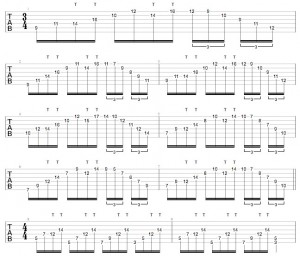
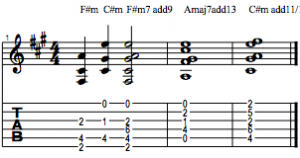
So, what are arbitrary chromatics? To say it simply, whenever you’re playing a minor (or major, or whatever mode) scale, in any position, you’ll have three tones on most of the strings, and two tones on one of the strings. This concept puts a chromatic passing tone on the string with two tones, so that each of the strings has three tones. This is great, especially for playing patterns or runs…


Tapping In Harmony Tapping In Harmony
By Faze

May 24th, 2011

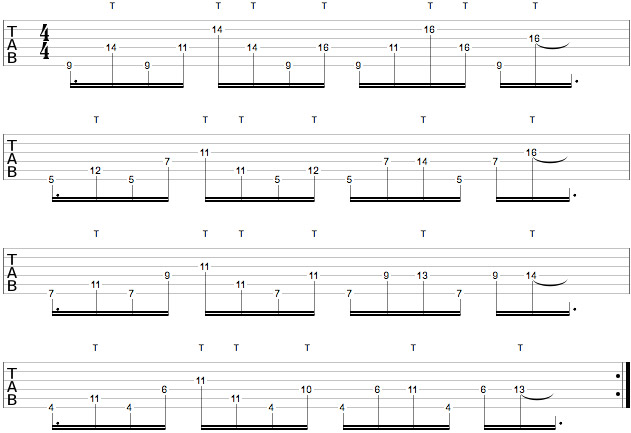
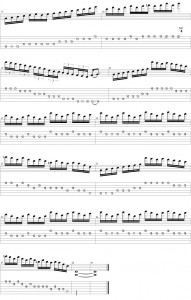
Hello Guitar Messenger readers! Today’s lesson focuses on spicing up chords by actively engaging both hands on the fretboard. Don’t be fooled by all the crazy-looking tapping you see in this video – as we move on you’ll realize that this is all a piece of cake. The main thing that I suggest here is to start slow and work your way up. I have provided you with full tracks and backing tracks of the full piece at 160bpm in the beginning, along with versions at 100bpm alongside each exercise, to help you build up to that speed. A few words before… (Continue)


Extended Range Composition Extended Range Composition
By David Maxim Micic

May 7th, 2011

Hey everyone! I’m David – guitar player, composer and producer for the band Destiny Potato. In this lesson I will show you the tuning that I use on my 6-string guitar along with some useful tips on how to create/compose interesting sounding riffs. I’ll also be playing a small solo section from my instrumental song ‘Bilo: part III’ from my upcoming EP Bilo at the end. GUITAR TUNING Since I’ve never had access to a 7-string guitar, I’ve adapted the tuning of a 6-string to give me access to the lower notes I want to use in my riffs. The… (Continue)


Creative Tapping Sequences Creative Tapping Sequences
By Stephen Ross

April 29th, 2011

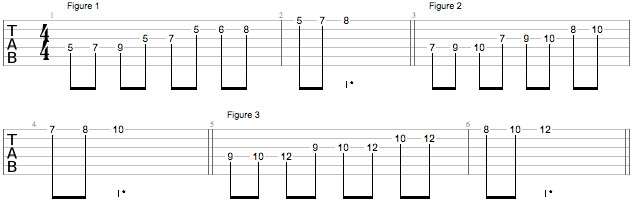
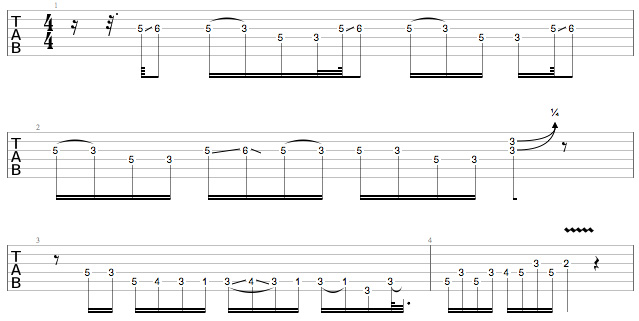
This lesson will explore tapping sequences that depart from the typical rock and metal patterns we all know and love. To drive this lesson, I will be extracting two sections from ‘Warp,’ the unaccompanied solo from my debut Shrapnel release Midnight Drive. All examples involve hammer-ons from nowhere in the left hand. The first three examples use the right hand’s middle finger to tap out notes, while the last three use the first and third fingers. I like using the middle finger for the single taps because I hold the pick in between my index finger and thumb. Using the… (Continue)


Sweeping Harmony Sweeping Harmony
By Jarle H. Olsen

April 22nd, 2011

I’m going to break down a segment of my song ‘Event Horizon,’ from my album Quadrasonic, for you to check out and study. For me, good composition always comes before anything else. I always try to paint the whole picture using all of the instruments. With this segment, I have added a lot of detail to the rhythm section and the chords underneath – otherwise it would just sound like a meaningless arpeggio sequence. What happens when you put all the elements of this arrangement in context is that the picture is completed, creating a strong melodic sense that sticks… (Continue)


Fusion Licks That Rock Fusion Licks That Rock
By Murilo Romano

March 29th, 2011

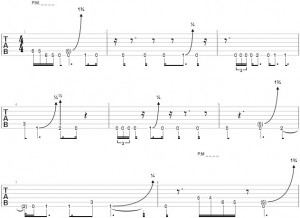
Hi, my name is Murilo Romano. It’s a great pleasure to be here with you! Today I’ll be using the solo from my song ‘Nostradamus’ to show you how to use chromatic approaches, arpeggios and tensions to give your licks an ‘outside’ sound.


Buying Your First Guitar: Part 2 Buying Your First Guitar: Part 2
By Zach Pino

November 9th, 2010

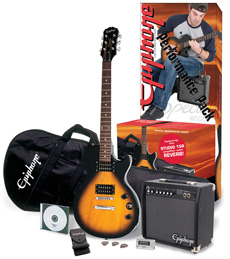
Welcome back! In Part 1 of this article, we looked at various considerations and research tips to guide your search for the right guitar. Now we will get into specifics with price ranges, accessories, and upgrade possibilities. Price Ranges/Value Packs Here are some guitars that fall into different price ranges for a beginner on a budget: $100-250 – Epiphone Les Paul Special, Ibanez RG120, Squier Telecaster Special, Squier Stratocaster Special, Dean Vendetta XM. In this price range, it’s best to go with a value package. Squier and Epiphone (the cheaper overseas companies for Fender and Gibson, respectively) offer great value… (Continue)


Buying Your First Guitar: Part 1 Buying Your First Guitar: Part 1
By Zach Pino

October 13th, 2010

Greetings to everyone at Guitar Messenger! I’m excited to have the opportunity to contribute to the Guitar Messenger community with this article. If you are a beginner who is thinking about buying your first guitar, you have come to the right place. Whether you have never picked up a guitar before or already know a few chords and riffs, I will point you in the right direction to making this important purchase. Ideally, you want to buy a guitar that will make you happy for years. You will be spending countless hours playing your instrument. You should buy a guitar… (Continue)


Basic Blues Substitutions Basic Blues Substitutions
By Dr. Matt Warnock

October 5th, 2010

Over the years I’ve found that while most guitarists have an easy time learning to comp and solo over the 12-bar blues, many people struggle when it comes time to expanding this well-known progression beyond the standard three chords. While there are many ways to apply chord substitutions to the 12-bar blues, I find that by applying one sub at a time, and keeping things simple, it’s easier to get these new chords under our fingers and in our ears. One of the first subs I teach within the context of a 12-bar blues is the #IV diminished 7th chord…. (Continue)


Ignition Part 1: Listening Ignition Part 1: Listening
By Jeremy Krull

September 28th, 2010

Now I know that since this is a recording column, naturally everyone wants to know what gear is good and what they should buy and who has good presets for this and that plugin…well there are more important matters at hand. If any of you remember, from the movie Conan The Barbarian, James Earl Jones’ character Thulsa Doom says at one point “What is steel, without the hand that wields it?!” and I’ll tell you why that makes the ultimate in sense. Obviously that’s a silly reference and an obscure one at that, but if you think about it…what sense… (Continue)


5 Tech Tools to Maximize Your Practice 5 Tech Tools to Maximize Your Practice
By Greg Arney

September 19th, 2010

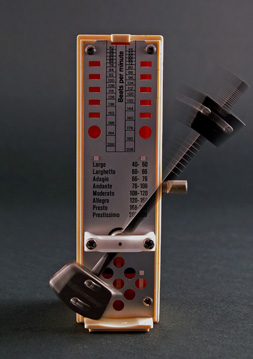
The metronome, invented in 1812, sounded the first four even beats of a new era for music technology. Since the onset of the digital age, recording and performance have changed dramatically. Listeners who are accustomed to hearing the post-human sounds of modern recordings have expectations of music performance which are not based on reality but on technological edits – both live and in the studio. The tech-savvy musician can use the tools available to augment his or her abilities and to practice in ways that were previously impossible. To ensure musical development, it’s important to use these tools but not… (Continue)


Tour Survival 101 Tour Survival 101
By Marcel Hamel

June 30th, 2010

I remember it perfectly. It was 19 weeks ago that I arrived in Manhattan, guitar in hand, frantically looking for Chelsea Studios. Chelsea is one of the larger theatrical rehearsal studios in New York City and while I’d played in a number of pit orchestras before, I’d also never had any reason to find the place because I wasn’t an actor. Today was different. Today I’d be meeting thirty other actors and musicians to depart for the national tour of the musical Cabaret. My contract was signed, I’d learned my parts and done my best to prepare for the next… (Continue)


Guitar Tone: Body Woods Guitar Tone: Body Woods
By Pasquale Campolattano

March 24th, 2010

Today we’ll discuss the piece of your guitar which many believe has the biggest influence on your sound – one which is a huge deciding factor for many folks when purchasing a new instrument. I am talking of course about the body wood of your guitar. Body wood plays a role in the sound of all guitars, but in this segment I will be speaking specifically about electric solid body guitars. A lot of players have a general idea of what a particular wood may sound like, but bear in mind that body wood alone is not the biggest factor in… (Continue)


Red Light District Red Light District
By Jeremy Krull

March 7th, 2010

Hello readers, if you’ve stumbled upon this then I guess you’re somewhat interested in the wide (and very confusing) world of audio production/recording. Throughout this series of columns we will touch on many different aspects of recording, from good equipment to start out with to methodology, to mixing, and many other small things along the way. In this introductory column we’ll glance over some of the very basic principles and ideals of recording/music production. And, before I forget, and I cannot stress this enough, this is about your ears, first and foremost. All for you? A rough estimate would be… (Continue)


Harmonic Overlapping Harmonic Overlapping
By Juliano Augusto

February 24th, 2010

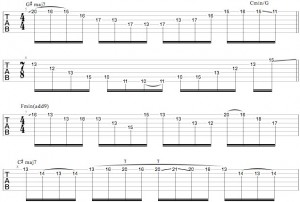
I first came about Harmonic Overlapping when studying the formation and inversion of chords, a subject that quickly became an obsession of mine. The idea of Harmonic Overlapping (a term I coined for lack of a better word) hit me when I realized that an Am7 chord (A C E G) was not only an inversion of a C add13 (C E G A), but a fusion of a C major chord and an A minor chord. Harmonic Overlapping is, in essence, simply that: the superimposition of two or more chords or intervals, diatonic or not (also known as polychord). This… (Continue)


Using a Metronome Effectively Part 4: Being One With the Tick Using a Metronome Effectively Part 4: Being One With the Tick
By Matt Baamonde

September 18th, 2008

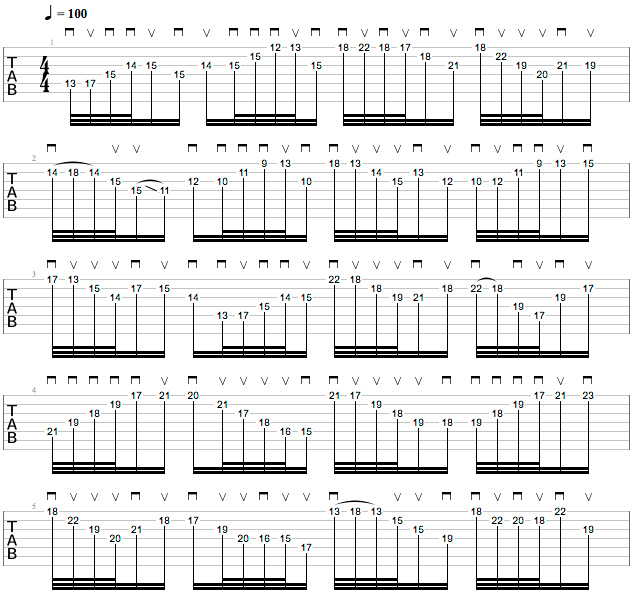
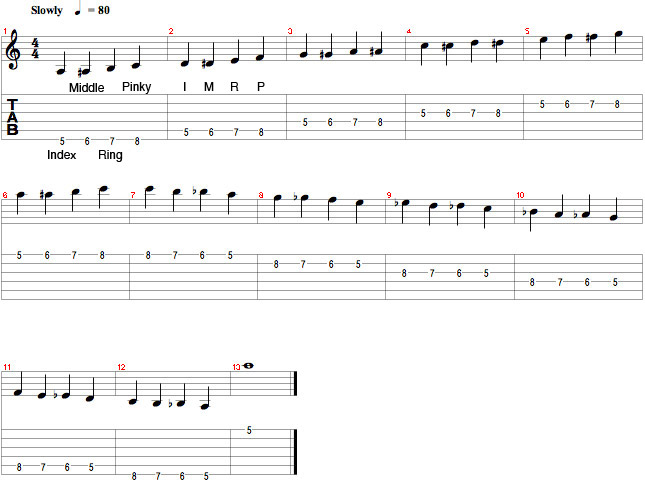
So you’ve got your metronome – (Part 1) – check. You understand the basics of rhythmic notation – (Part 2) – check. And now you’ve got a great warm up and know how to work moveable finger patterns in time – (Part 3) – check. Now its time to apply everything you’ve learned and use them to play some licks in a real musical situation. The following example is a minute long rock/metal/shred tune that features a medium/fast rock tempo and a series of sixteenth note runs in the G Phrygian mode. (If the modes are new to you, you… (Continue)


Using a Metronome Effectively Part 3: Clocking Your Speed Using a Metronome Effectively Part 3: Clocking Your Speed
By Matt Baamonde

January 28th, 2008

So now that you’re set up with a quality metronome (Part 1) and understand the basics of how rhythmic time is divided, (Part 2) lets actually start applying some of it and learning some moving patterns. Notes on setup: Since we are ready to play examples, you will need your electric or acoustic guitar. I advocate an electric with an amplifier with an adjustable volume control. This way you can set your instrument’s volume slightly softer than the volume of your metronome. You’ll always want to start practicing without distortion. Think of a clean jazz tone… for you all you… (Continue)


Advanced Tapping: Extended Arpeggios Advanced Tapping: Extended Arpeggios
By Bill Peck

January 1st, 2008

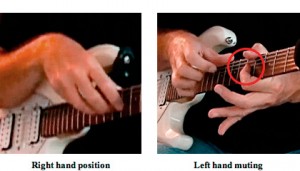
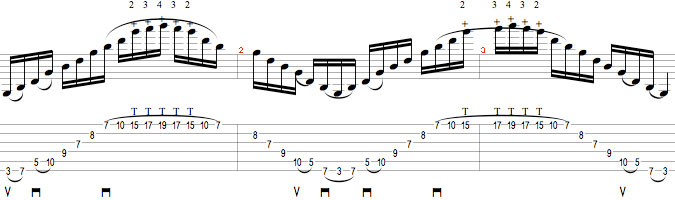
For many guys that want to tap better, they do not have the hand strength or built up dexterity to hammer onto the fretboard hard enough. You must hammer with some real power and try to be as accurate as possible in the placement of the hammering finger relative to the fret and adjacent strings.


Using a Metronome Effectively Part 2: Things Start to Click Using a Metronome Effectively Part 2: Things Start to Click
By Matt Baamonde

October 18th, 2007

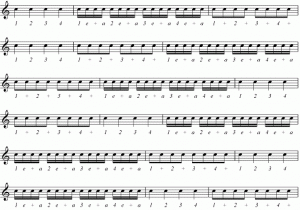
Now that you know what to look for when you purchase a metronome (Part 1), let’s get started with actually practicing with one. A lot of this may be review for more advanced players, but you may want to skim through and see if there any rusty spots in your playing or knowledge. When you’re getting set up you’ll want to practice with a pick, and if you’re playing amplified, it’s better to practice clean before adding distortion so you can work on playing with clarity and precision that distortion can cover up. Old Joke: How do you send a… (Continue)


Using a Metronome Effectively Part 1: Nervous Tick? Using a Metronome Effectively Part 1: Nervous Tick?
By Matt Baamonde

October 17th, 2007

If you are a half capable guitarist you’ve probably heard the words, “Play something really fast,” by your friends, and it’s usually meant as a challenge to test your chops. But what does playing something fast really mean? Is someone clocking the amount of time it takes you to play x amount of notes from point A to point B? And even if you’re moving at the speed of sound is that really a valuable skill as a guitarist, or more importantly, as a musician? If you’ve ever listened to, or seen guitarists, that fall under the progressive rock, neoclassical… (Continue)


Artist Management Artist Management
By Andy Zhang

October 16th, 2007

Managing your career can be a daunting task. That’s why the artist management profession exists! If you actually break down what a manager does, you start to see that he/she has to do a little bit of everything. For those of you who are unsigned or simply don’t plan on signing with a label, a manager then must do a lot of everything in order to compensate.If your band is just starting out, the following article may not apply to you yet; you should be playing out quite often and have a solid original repertoire to warrant the need for… (Continue)