Stepping Out: A Guide To Playing Outside (Part 1)
Lessons > Jazz
Stepping Out: A Guide To Playing Outside (Part 1)By Thomas Williams
December 23rd, 2011
Playing ‘outside’ is a term synonymous with jazz rock/fusion guitar players. Within traditional forms of jazz this term is replaced by ‘using chromaticism.’ In blues, country, and folk forms it’s called ‘blue notes.’ In everything else it’s considered ‘the wrong notes.’ In all forms, however, the common goal is to play a note that clashes against the background harmony in order to create tension and thus reinforce resolution when it arrives.
Arbitrary Chromatics: The Bonehead Easy Way To Get A Jazzy SoundBy Morten Faerestrand
September 28th, 2011
So, what are arbitrary chromatics? To say it simply, whenever you’re playing a minor (or major, or whatever mode) scale, in any position, you’ll have three tones on most of the strings, and two tones on one of the strings. This concept puts a chromatic passing tone on the string with two tones, so that each of the strings has three tones. This is great, especially for playing patterns or runs…
Putting Jazz In Metal With Ever ForthrightBy Nicholas Llerandi
February 17th, 2011
Welcome to Guitar Messenger! I’m Nick from the band Ever Forthright. Today we’re going to use excerpts from two of our recent songs, ‘The Counter Shift‘ and ‘Dispose Of Your Optimism‘, to demonstrate how you can use jazz harmony and concepts in modern progressive metal. All examples are played on an 8-string in standard tuning: F# B E A D G B E Passing Tones – The Counter Shift 1:43: This section is a great example of using passing tones (labeled PT in the tabs) to connect chords in a riff or progression. This section is pretty much a ‘techy’ take… (Continue)
A Lesson On Tensions Part 2: Putting the Voicings Into ActionBy Mark Kilianski
February 12th, 2011
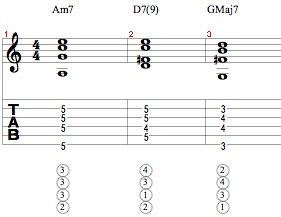
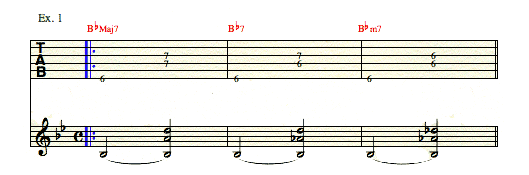
In my last lesson I bombarded you with tons of thick, gooey tension-filled voicings, and explained how they work. As we all know, with new knowledge comes new responsibility. When and how should these voicings be used? That’s an excellent question, so I’ll give you a couple of suggestions and show you how using tensions in your chord voicings can spice up some great jazz standards. Tensions are an important part of what makes Jazz harmony so rich and pretty. In example 1A you can hear how 7th chords without any tensions sound in the timeless ‘There Is No Greater… (Continue)
A Lesson On Tensions: Can You Paint With All the Colors of the Jazz Chord?By Mark Kilianski
October 28th, 2010
What’s so great about Jazz? What about that sound is so appealing? Why should we as guitarists take the time to study Jazz, even if we do not intend to play jazz gigs? Well, there are many answers, but one that really stands out, especially for us guitarists, is the rich harmonic sound of a Jazz chord voicing. The chords that a Jazz player uses are denser and richer than those of most rock, pop, funk, and countless other styles of music, and so we will dive right into the warm, thick, colorful waters of tensions. From the beginning, Jazz… (Continue)
The Almighty ii-V: Part 2 (Minor)By Mark Kilianski
September 7th, 2010
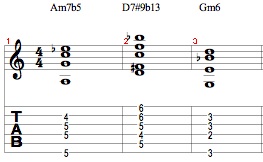
Sultry. Spicy. Rich. Exotic. No, I am not talking about your mother. I’m talking about Jazz standards in minor keys. Though they make up a smaller percentage of the Jazz repertoire, minor tunes add a great variety and sound to any performance, album, or jam session. Even if the tune you are playing is in a major key, there’s probably at least a hint of minor in there. And if it’s Jazz it’s probably got a ii-V in it. This article will focus on playing over a ii-V progression in minor keys. The ii chord in a minor key is… (Continue)
Altered Dimensions: The Altered Dominant ChordBy Mark Kilianski
June 14th, 2010
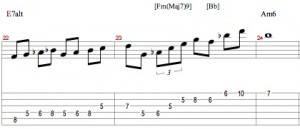
The Altered Scale. Sound scary? Well it is. It’s a 20 story tall, fire-breathing beast with enough tension in it to break the entire universe into infinite little pieces and eat them all in one bite. But that’s why it’s so great. If you learn to tame this beast it can add a hip, sophisticated, and wild edge to your playing, and is relevant beyond the scope of Jazz music alone. And it’s actually not that hard once you get used to it. The altered scale came about in the Bebop era of Jazz when musicians were exploring new harmonic… (Continue)
The Almighty ii-V: Part 1 (Major)By Mark Kilianski
February 9th, 2010
The ii-V. All hail the ii-V. Never question it. Accept it. Embrace it. And then once you’re sick of it you can puke it out all over the place. The ii-V-I progression is the most important chord progression in Jazz music, equitable with I-IV-V in Pop music. There are tunes with harmony constructed solely on the ii-V, and it appears in about 85% of the standard repertoire. So if you want to play Jazz, then it’s a good idea to get to know this guy. He’ll get you a long way. Let’s figure out how to construct, play, and play… (Continue)
Scott Henderson’s “Stella by Infra-Red High Particle Neutron Beam” SoloBy Francesco Artusato
September 25th, 2008
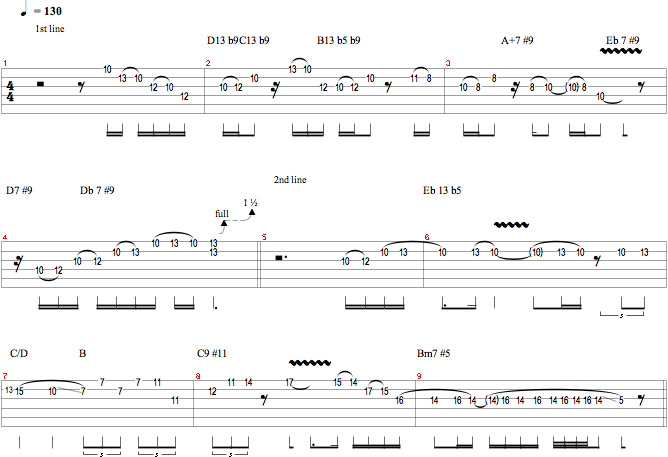
Welcome back to the Technical Difficulties column! As I previously did with the “Day of the Dead” solo by Allan Holdsworth, today I am going to analyze and play a solo by one of my favorite guitar players of all time: Scott Henderson. Scott is a phenomenal musician who has widely expanded the guitar language throughout the years, particularly in the jazz/fusion and blues context. He is known especially for his great sense of phrasing, touch, dynamic control, amazing time, and incredible attention for articulations. He has been recording and playing around the world in different collaborations and projects for… (Continue)
Putting It Together: Playing Bass Lines & Guide Tones SimultaneouslyBy Mark Kilianski
February 21st, 2008
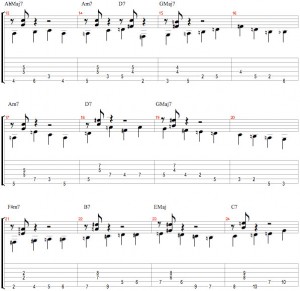
It’s great to be able to play guide tones as a stripped down approach to comping, and it’s awesome to be able to play bass lines when a bass instrument isn’t covering the low end. Combining the two techniques yields a great way to comp in a setting devoid of another bass and chord instrument, such as a duo or trio without bass, piano, tuba, harp, accordion, or any other bass and/or chord instrument. The most basic way to do this is by playing a bass line and inserting guide tone stabs at certain points. Ex.1: All The Things You… (Continue)
Down in the Basement: Constructing Bass Lines on GuitarBy Mark Kilianski
January 3rd, 2008
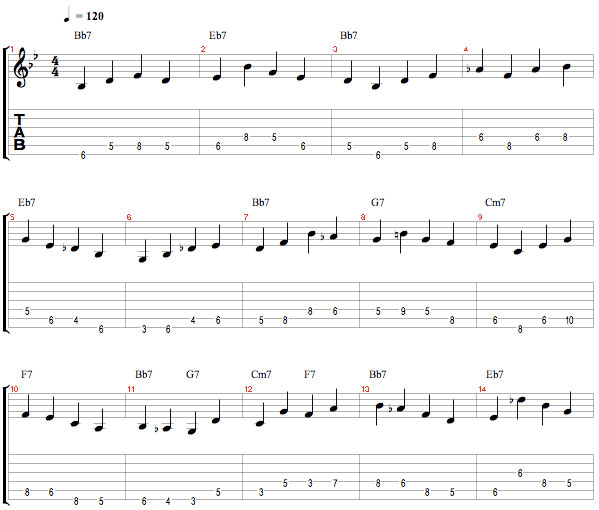
As guitarists, our primary role in a jazz setting is to play chords, and very often we also play melody and/or solos. Because of our main function, it can be easy to overlook the usefulness of knowing how to construct a good bass line.
Allan Holdsworth’s “Day of the Dead” SoloBy Francesco Artusato
October 28th, 2007
Welcome to my second column/lesson! This month I’d like to talk about one of my favorite players of all time – Allan Holdsworth. He’s been a big influence in the electric guitar world, and has helped expand the musical vocabulary of countless players throughout the last three decades. Allan has always tried to push the physical and harmonic limits of his playing/instrument, and over the years has practically created his own language on the instrument and in the genre of fusion. Holdsworth represents everything that is good in the realm of guitar: from his impeccable time and touch, to his… (Continue)
Guide Tones: The Bare EssentialsBy Mark Kilianski
October 15th, 2007
Very often, “less is more” is a good policy to adopt when playing jazz. Overplaying usually gets both players and listeners pissed off because you’re getting in the way of the other musicians, while creating cluttered, disorganized music.