Contact   |   Staff  |   Contribute  |   Advertise  |   Site Map  |   Legal

Metal Foundations Lesson 3: Intermediate Riff Concepts

Lessons > Technique

Metal Foundations Lesson 3: Intermediate Riff Concepts Metal Foundations Lesson 3: Intermediate Riff Concepts
By Zach Pino

October 11th, 2011

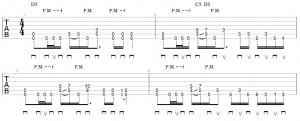
Welcome back, metal Guitar Messengers! The last lesson introduced you to some basic riff construction concepts based off of common chord diads and the palm muting technique. In this lesson, we’re going to dive right into some more advanced riff concepts. These include the use of tritones, bending techniques, and the use of palm-muted rests to create syncopated grooves. The riffs in this lesson are all in Drop D tuning, with the exception of Figure 3, which is in standard tuning. And as always, we’ll conclude the lesson with some essential metal albums that illustrate these concepts. Sound good? Let’s… (Continue)


Tapping In Harmony Tapping In Harmony
By Faze

May 24th, 2011

Hello Guitar Messenger readers! Today’s lesson focuses on spicing up chords by actively engaging both hands on the fretboard. Don’t be fooled by all the crazy-looking tapping you see in this video – as we move on you’ll realize that this is all a piece of cake. The main thing that I suggest here is to start slow and work your way up. I have provided you with full tracks and backing tracks of the full piece at 160bpm in the beginning, along with versions at 100bpm alongside each exercise, to help you build up to that speed. A few words before… (Continue)


Future Metal Shred Future Metal Shred
By Paul Wardingham

May 16th, 2011

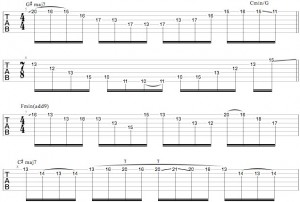
Welcome to Guitar Messenger! My name is Paul Wardingham, and I’m going to be showing you how to play some futuristic-themed shred ideas using excerpts from my new album Assimilate Regenerate, as well as a solo written and recorded exclusively for this lesson. Whenever a student asks me how to play so-called ‘futuristic’ sounding licks, there are certain techniques and scales that always seem to spring to mind when trying to create this sound. Ex 1. Sweeping Sus2 Arpeggios – Cyber Warfare (4:31) Example 1 is taken from the last solo in the track ‘Cyber Warfare,’ and uses a sequence of… (Continue)


Creative Tapping Sequences Creative Tapping Sequences
By Stephen Ross

April 29th, 2011

This lesson will explore tapping sequences that depart from the typical rock and metal patterns we all know and love. To drive this lesson, I will be extracting two sections from ‘Warp,’ the unaccompanied solo from my debut Shrapnel release Midnight Drive. All examples involve hammer-ons from nowhere in the left hand. The first three examples use the right hand’s middle finger to tap out notes, while the last three use the first and third fingers. I like using the middle finger for the single taps because I hold the pick in between my index finger and thumb. Using the… (Continue)


Sweeping Harmony Sweeping Harmony
By Jarle H. Olsen

April 22nd, 2011

I’m going to break down a segment of my song ‘Event Horizon,’ from my album Quadrasonic, for you to check out and study. For me, good composition always comes before anything else. I always try to paint the whole picture using all of the instruments. With this segment, I have added a lot of detail to the rhythm section and the chords underneath – otherwise it would just sound like a meaningless arpeggio sequence. What happens when you put all the elements of this arrangement in context is that the picture is completed, creating a strong melodic sense that sticks… (Continue)


Metal Foundations Lesson 2: Riff Concepts Metal Foundations Lesson 2: Riff Concepts
By Zach Pino

April 3rd, 2011

Welcome back, fellow metallers! Last lesson, I introduced some basic rhythmic subdivisions and the palm muting technique. Expanding on palm muting and timing importance, this lesson will examine some ways to go about creating original riffs with common chord diads, rhythmic embellishments, and knowing when and when not to palm mute. Common Diads – Perfect 5th, Perfect 4th, Major 3rd, Minor 3rd, Minor 6th The following examples illustrate common chord diads based in the key of D. Two-note chords are great for adding tonal variation to your riffs. Diads are not full chords, but the intervals relative to the root… (Continue)


Metal Foundations Lesson 1: Rhythm Guitar Development Metal Foundations Lesson 1: Rhythm Guitar Development
By Zach Pino

January 24th, 2011

What’s that? You want to learn some metal guitar? You’re a beginner, too? No way! You came to the right place, my friend. Welcome to the first lesson in this beginning metal guitar series. With these lessons, I will lay the foundations for developing solid and precise metal technique. Whether you’re a novice guitarist or just want to brush up on some technique, this series will offer beginner-intermediate exercises and concepts to help you on your way to metal mastery. With patience, practice and a decent electric guitar and amp, you’ll be chugging out brutal riffs in no time. If… (Continue)


Diminished Possibilities: Part 2 Diminished Possibilities: Part 2
By Francesco Artusato

February 21st, 2009

Hey guys! Welcome again to my “Technical Difficulties” column – this is number 6 already! As the title suggests, this is the second part of a previous column I wrote for Guitar Messenger, so feel free to check it out and leave me comments in the “Ask Francesco” section of the forum. This time I am going to dive a little deeper into the Octatonic scale. I want to show you some of the sounds “hidden” inside the typical diminished shapes that all guitar players know and have come to love and use on a consistent basis. It is really… (Continue)


Scott Henderson’s “Stella by Infra-Red High Particle Neutron Beam” Solo Scott Henderson’s “Stella by Infra-Red High Particle Neutron Beam” Solo
By Francesco Artusato

September 25th, 2008

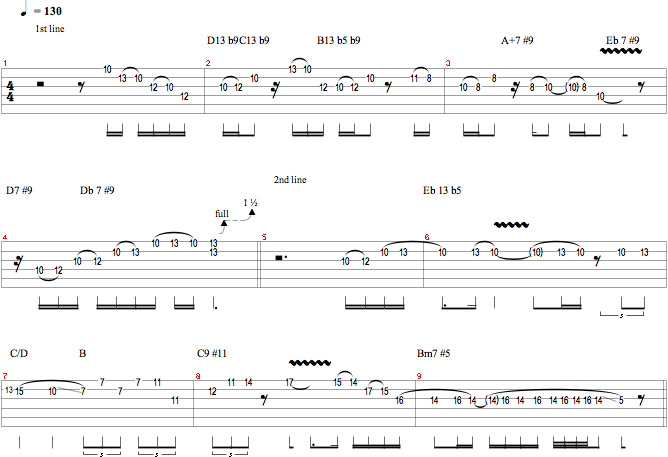
Welcome back to the Technical Difficulties column! As I previously did with the “Day of the Dead” solo by Allan Holdsworth, today I am going to analyze and play a solo by one of my favorite guitar players of all time: Scott Henderson. Scott is a phenomenal musician who has widely expanded the guitar language throughout the years, particularly in the jazz/fusion and blues context. He is known especially for his great sense of phrasing, touch, dynamic control, amazing time, and incredible attention for articulations. He has been recording and playing around the world in different collaborations and projects for… (Continue)


Using a Metronome Effectively Part 4: Being One With the Tick Using a Metronome Effectively Part 4: Being One With the Tick
By Matt Baamonde

September 18th, 2008

So you’ve got your metronome – (Part 1) – check. You understand the basics of rhythmic notation – (Part 2) – check. And now you’ve got a great warm up and know how to work moveable finger patterns in time – (Part 3) – check. Now its time to apply everything you’ve learned and use them to play some licks in a real musical situation. The following example is a minute long rock/metal/shred tune that features a medium/fast rock tempo and a series of sixteenth note runs in the G Phrygian mode. (If the modes are new to you, you… (Continue)


2-1-2 Arpeggio Permutations 2-1-2 Arpeggio Permutations
By Francesco Artusato

May 22nd, 2008

Welcome to my fourth column/lesson. This time I would like to talk about a component of guitar playing that has always fascinated me: arpeggio permutations/fragments. Playing arpeggio fragments can make one’s playing more colorful, usually helping a musical phrase sound harmonically richer and more diverse.


Using a Metronome Effectively Part 3: Clocking Your Speed Using a Metronome Effectively Part 3: Clocking Your Speed
By Matt Baamonde

January 28th, 2008

So now that you’re set up with a quality metronome (Part 1) and understand the basics of how rhythmic time is divided, (Part 2) lets actually start applying some of it and learning some moving patterns. Notes on setup: Since we are ready to play examples, you will need your electric or acoustic guitar. I advocate an electric with an amplifier with an adjustable volume control. This way you can set your instrument’s volume slightly softer than the volume of your metronome. You’ll always want to start practicing without distortion. Think of a clean jazz tone… for you all you… (Continue)


Diminished Possibilities: Part 1 Diminished Possibilities: Part 1
By Francesco Artusato

January 9th, 2008

Welcome to my third column/lesson. This time I’d like to talk a little bit about diminished scales/arpeggios with their possible application solos. Knowing how to use a diminished “idea” represents a very powerful tool to create moments of musical tension. A diminished/octatonic scale is a symmetrical scale (whose intervallic relationship is symmetrical) composed of 8 notes. There are 2 modes of a given diminished/octatonic set: whole/half/whole/half and so on, or half/whole/half/whole and so on. It’s a very easy scale to use on an instrument like the guitar, because even though there are 8 notes in it, there are only two… (Continue)


Advanced Tapping: Extended Arpeggios Advanced Tapping: Extended Arpeggios
By Bill Peck

January 1st, 2008

For many guys that want to tap better, they do not have the hand strength or built up dexterity to hammer onto the fretboard hard enough. You must hammer with some real power and try to be as accurate as possible in the placement of the hammering finger relative to the fret and adjacent strings.


Allan Holdsworth’s “Day of the Dead” Solo Allan Holdsworth’s “Day of the Dead” Solo
By Francesco Artusato

October 28th, 2007

Welcome to my second column/lesson! This month I’d like to talk about one of my favorite players of all time – Allan Holdsworth. He’s been a big influence in the electric guitar world, and has helped expand the musical vocabulary of countless players throughout the last three decades. Allan has always tried to push the physical and harmonic limits of his playing/instrument, and over the years has practically created his own language on the instrument and in the genre of fusion. Holdsworth represents everything that is good in the realm of guitar: from his impeccable time and touch, to his… (Continue)


Using a Metronome Effectively Part 2: Things Start to Click Using a Metronome Effectively Part 2: Things Start to Click
By Matt Baamonde

October 18th, 2007

Now that you know what to look for when you purchase a metronome (Part 1), let’s get started with actually practicing with one. A lot of this may be review for more advanced players, but you may want to skim through and see if there any rusty spots in your playing or knowledge. When you’re getting set up you’ll want to practice with a pick, and if you’re playing amplified, it’s better to practice clean before adding distortion so you can work on playing with clarity and precision that distortion can cover up. Old Joke: How do you send a… (Continue)


Using a Metronome Effectively Part 1: Nervous Tick? Using a Metronome Effectively Part 1: Nervous Tick?
By Matt Baamonde

October 17th, 2007

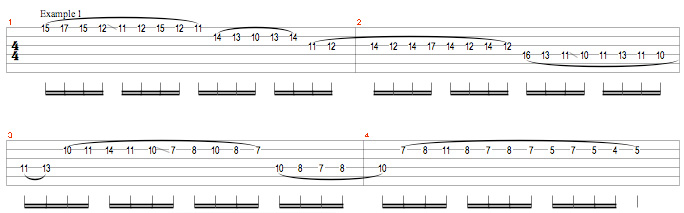
If you are a half capable guitarist you’ve probably heard the words, “Play something really fast,” by your friends, and it’s usually meant as a challenge to test your chops. But what does playing something fast really mean? Is someone clocking the amount of time it takes you to play x amount of notes from point A to point B? And even if you’re moving at the speed of sound is that really a valuable skill as a guitarist, or more importantly, as a musician? If you’ve ever listened to, or seen guitarists, that fall under the progressive rock, neoclassical… (Continue)


Different Groupings & Finger Independence Different Groupings & Finger Independence
By Francesco Artusato

October 15th, 2007

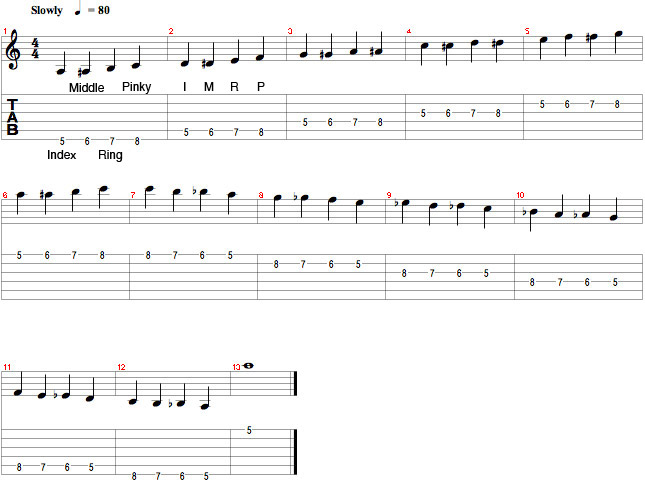
One of the most essential things that a guitar player can try to develop is the independence of fretting hand digits (equal control over every finger). There are lots of exercises that help to achieve this, and I think one of the best ones is the common 1-2-3-4 chromatic exercise across all strings. It can seem simple, but playing all the different permutations (1-2-3-4/1-2-4-3-/1-3-2-4/1-3-4-2/1-4-3-2/1-4-2-3/ and so on) with a balanced touch and good time while only using hammer-on’s and pull-off’s can be really demanding. In the long run, however, such control can be truly effective, and will open many doors… (Continue)