Metal Foundations Lesson 3: Intermediate Riff Concepts
Lessons > Theory
Metal Foundations Lesson 3: Intermediate Riff ConceptsBy Zach Pino
October 11th, 2011
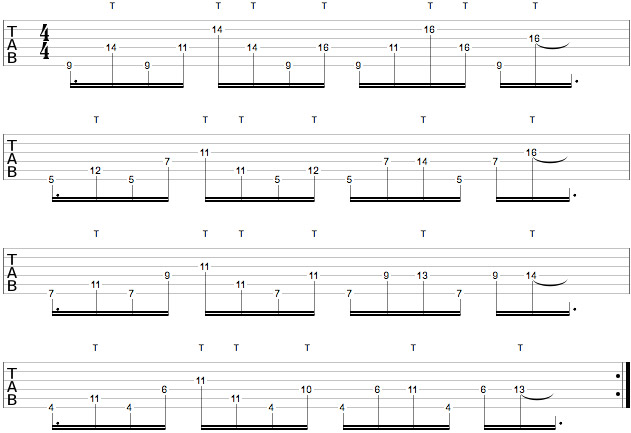
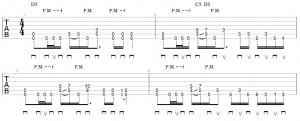
Welcome back, metal Guitar Messengers! The last lesson introduced you to some basic riff construction concepts based off of common chord diads and the palm muting technique. In this lesson, we’re going to dive right into some more advanced riff concepts. These include the use of tritones, bending techniques, and the use of palm-muted rests to create syncopated grooves. The riffs in this lesson are all in Drop D tuning, with the exception of Figure 3, which is in standard tuning. And as always, we’ll conclude the lesson with some essential metal albums that illustrate these concepts. Sound good? Let’s… (Continue)
Tapping In HarmonyBy Faze
May 24th, 2011
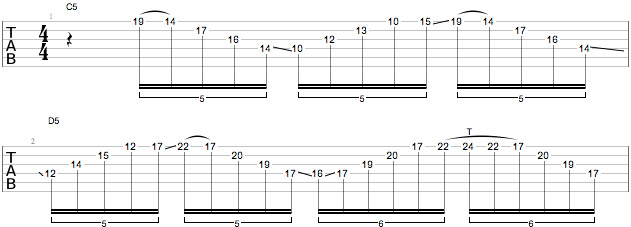
Hello Guitar Messenger readers! Today’s lesson focuses on spicing up chords by actively engaging both hands on the fretboard. Don’t be fooled by all the crazy-looking tapping you see in this video – as we move on you’ll realize that this is all a piece of cake. The main thing that I suggest here is to start slow and work your way up. I have provided you with full tracks and backing tracks of the full piece at 160bpm in the beginning, along with versions at 100bpm alongside each exercise, to help you build up to that speed. A few words before… (Continue)
Future Metal ShredBy Paul Wardingham
May 16th, 2011
Welcome to Guitar Messenger! My name is Paul Wardingham, and I’m going to be showing you how to play some futuristic-themed shred ideas using excerpts from my new album Assimilate Regenerate, as well as a solo written and recorded exclusively for this lesson. Whenever a student asks me how to play so-called ‘futuristic’ sounding licks, there are certain techniques and scales that always seem to spring to mind when trying to create this sound. Ex 1. Sweeping Sus2 Arpeggios – Cyber Warfare (4:31) Example 1 is taken from the last solo in the track ‘Cyber Warfare,’ and uses a sequence of… (Continue)
Extended Range CompositionBy David Maxim Micic
May 7th, 2011
Hey everyone! I’m David – guitar player, composer and producer for the band Destiny Potato. In this lesson I will show you the tuning that I use on my 6-string guitar along with some useful tips on how to create/compose interesting sounding riffs. I’ll also be playing a small solo section from my instrumental song ‘Bilo: part III’ from my upcoming EP Bilo at the end. GUITAR TUNING Since I’ve never had access to a 7-string guitar, I’ve adapted the tuning of a 6-string to give me access to the lower notes I want to use in my riffs. The… (Continue)
Sweeping HarmonyBy Jarle H. Olsen
April 22nd, 2011
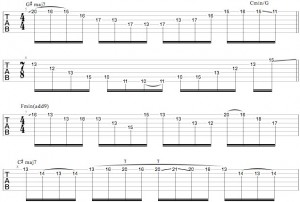
I’m going to break down a segment of my song ‘Event Horizon,’ from my album Quadrasonic, for you to check out and study. For me, good composition always comes before anything else. I always try to paint the whole picture using all of the instruments. With this segment, I have added a lot of detail to the rhythm section and the chords underneath – otherwise it would just sound like a meaningless arpeggio sequence. What happens when you put all the elements of this arrangement in context is that the picture is completed, creating a strong melodic sense that sticks… (Continue)
Metal Foundations Lesson 2: Riff ConceptsBy Zach Pino
April 3rd, 2011
Welcome back, fellow metallers! Last lesson, I introduced some basic rhythmic subdivisions and the palm muting technique. Expanding on palm muting and timing importance, this lesson will examine some ways to go about creating original riffs with common chord diads, rhythmic embellishments, and knowing when and when not to palm mute. Common Diads – Perfect 5th, Perfect 4th, Major 3rd, Minor 3rd, Minor 6th The following examples illustrate common chord diads based in the key of D. Two-note chords are great for adding tonal variation to your riffs. Diads are not full chords, but the intervals relative to the root… (Continue)
Harmonic OverlappingBy Juliano Augusto
February 24th, 2010
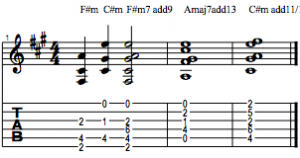
I first came about Harmonic Overlapping when studying the formation and inversion of chords, a subject that quickly became an obsession of mine. The idea of Harmonic Overlapping (a term I coined for lack of a better word) hit me when I realized that an Am7 chord (A C E G) was not only an inversion of a C add13 (C E G A), but a fusion of a C major chord and an A minor chord. Harmonic Overlapping is, in essence, simply that: the superimposition of two or more chords or intervals, diatonic or not (also known as polychord). This… (Continue)
Messiaen – Canteyodjaya [1949]By Roberto Toscano
January 20th, 2008
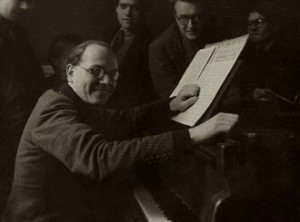
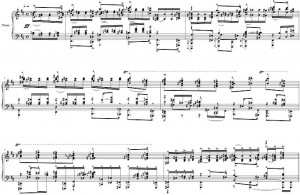
Welcome back to Beyond Theory and to what already is column #5! Today we will be talking about Hindu Rhythms as applied by Oliver Messiaen (1908-1992) in his composition titled Canteyodjaya (Solo Piano) – as well as going over a few other compositional techniques employed in this study. This work amounts to what is essentially a short (ca. 12 minutes) piece on Hindu rhythms, which Messiaen finished composing while visiting Tanglewood, MA in August 1949 (and not 1948 – as most sources state). You will notice that Messiaen will use authentic names for each rhythm in the piece, meaning he… (Continue)
Polyphonic Writing for Keyboard: Part 1By Roberto Toscano
January 4th, 2008
Hello and welcome back to Beyond Theory. In this column I would like us to get away from THEORY altogether and look closer at texturing and things approximate to the realm of composition. Over the course of the last few years I have come to realize that most people do not truly appreciate how versatile the piano can be when writing for it. By versatility I do not mean styles of music at all, but actually how the piano can be utilized to play many different lines and textures at the same time – its polyphonic capabilities. For the purpose… (Continue)
The Octatonic Scale & Symphony of Psalms (Stravinsky)By Roberto Toscano
October 17th, 2007
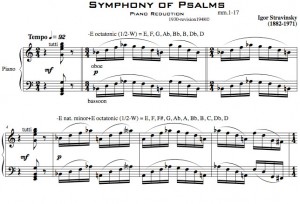
I mentioned in the introduction to this column that it was my goal to talk about certain topics that rarely get mentioned on guitar related sites, or for that matter any site that is out there. This will be the first such column that I write for this site, which essentially deals with one or more works by a composer, and deals with an application of a topic that is not common to most guitar players or at least is an expansion on certain things guitar players might have heard about but never understood or saw applied. For this column… (Continue)
Minor Scale HarmonyBy Roberto Toscano
October 16th, 2007
In the last column we talked about harmonizing the Major Scale in 3rds so that we could find all diatonic chords for that scale from each of its degrees. In doing so we ended up harmonizing every degree of that scale until we had every possible diatonic tension stacked on all of the seven degrees of said scale. For this column the goal will be much the same. We will continue with the tertian harmonization and apply it to natural minor, melodic minor, and finally harmonic minor scales. What will happen is that we will then have seven different chord… (Continue)
Major Scale HarmonyBy Roberto Toscano
October 15th, 2007
For this first column, I feel its best that we start off with something simple. The purpose of this column is to show which chords can be derived from the Major Scale, how one would come to these said chords and what possible tensions can be applied to each chord while remaining diatonic to the “mother” scale. A few things to note: All examples can be transposed into any other key, though for the majority of this column I will be using C major as our primary scale, this will make the given information easier to digest. The harmonization applied… (Continue)