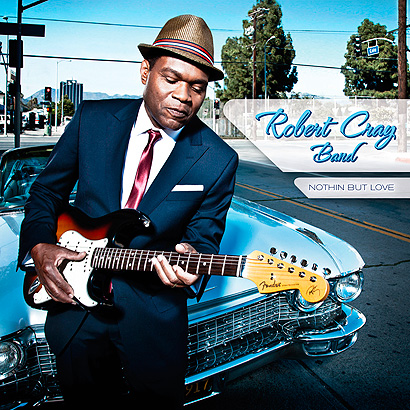
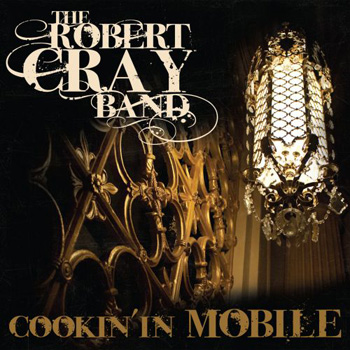
The Robert Cray Band – Cookin’ In Mobile
August 23rd, 2010 in CD/DVD, Reviews by Chris DingmanRelease Date: July 27, 2010
After decades of serving up smooth, soul-infused blues, singer and master guitarist Robert Cray has at last released a live DVD to give viewers at home the chance to experience one of music’s classiest acts. Fortunately for us, Cray made sure to get things done right.
The camera work is excellent, with edits lingering long enough on individual shots to spotlight the playing. His creative chord voicings, which help elevate excellent songs like ‘Our Last Time,’ ‘One In The Middle’ and ‘Time Makes Two’ are well-framed by the skilled camera crew.
Cray’s distinctively Stratty guitar playing is outstanding, and the many nuances in his bends, vibrato and pick attack are ably captured here. The mix itself is strong, with a good balance between the instruments, although Cray’s vocals are mixed high enough that they occasionally obscure his great guitar work. Happily, during his many excellent solos, his playing always comes through with perfect clarity.
Although Cray’s expressive voice and playing shine throughout blues jams and ballads alike, he is at his very best during soulful numbers like ‘Love 2009,’ ‘Lotta Lovin’’ and ‘Time Makes Two.’ ‘Love 2009’ in particular is loaded with earnest passion and a chorus that hits home every time, while the uptempo ‘Chicken In The Kitchen’ is both fiery and filled with cheeky, good-natured humor. Cray’s guitar playing stands out during concert staple ‘Smoking Gun,’ where his barrage of dynamic and wrenching solos drive the performance to escalating heights.
The chemistry between Cray and his band persists through every solo, every transition and every ending and gives the entire set an incredibly intimate vibe. When Cray takes his second solo in ‘Anytime,’ the dynamic drumming of Tony Braunagel helps him expand the emotional impact of his solo by ratcheting up the intensity at the ideal moment.
Throughout the set, the smooth and rumbling tone of Richard Cousins’ bass playing is matched by his unshakable groove and playful, engaging stage presence. Although the string patch during ‘Time Makes Two’ could be more organic, everything else in keyboardist Jim Pugh’s array of sounds suits the soul and blues settings nicely, and his solo during ‘One In The Middle’ is so tasteful that it becomes a natural extension of the song.
After the show is over, the DVD still has a few bonus features to unveil – including a nice set of interviews with Cray and his band about his background, the formation of the band and the development of their latest album, This Time. All in all, this DVD/CD package has a lot to offer fans of modern blues and soul, and is essential for followers of Robert Cray.
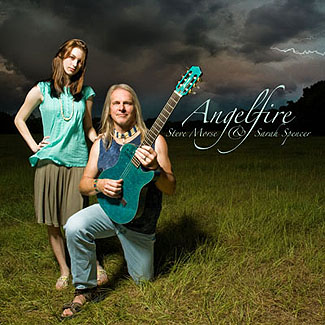
Steve Morse & Sarah Spencer – Angelfire
August 10th, 2010 in CD/DVD, Reviews by Chris Dingman
Release Date: August 10, 2010
Throughout Steve Morse’s memorable career he has written music that draws on hard rock, country, British fusion and baroque classical. Angelfire, the debut album from his latest project of the same name, finds Morse applying his gifts to yet another genre: acoustic vocal music.
Morse and his partner in Angelfire, the talented Sarah Spencer, share a powerful musical chemistry. Drawing on his experience with instrumental music, Morse creates compelling progressions for songs like ‘What Made You Think?’ that bring Spencer’s strong melodies to life. For her part, Spencer’s flowing delivery drives reflective songs like the excellent opener ‘Far Gone Now’ and adds a gentle insistence to groovier songs like ‘Terrible Thing To Lose.’
While a classical influence dominates the mesmerizing ‘Omnis Morse Aequat,’ and the album closer ‘Urban Decay’ draws on acoustic pop, most songs fuse the two styles with quiet elegance. Even in ‘Omnis Morse Aequat,’ which recalls the calmer compositions that often appear on Morse’s solo albums, the addition of Spencer’s harmonies allows the piece to become something ethereal. Likewise, the simplicity of ‘Urban Decay’ is supported by Morse’s skillful use of harmony – he keeps things interesting, but never so complicated as to become distracting.
Although Morse favors dynamic arpeggios over searing leads throughout the album, he does take tasteful acoustic solos during the affecting ‘Here Today’ and ‘Terrible Thing To Lose.’ Morse even breaks out the electric for a restrained but blazing outro solo during the prog-influenced ‘Take It Or Leave It.’
Angelfire’s production, handled by Morse himself, handles the balance between guitar and vocals nicely. Through layering and the judicious use of reverb, Morse and Spencer expand on the space created by Morse regulars Dave LaRue and Van Romaine on bass and drums. Aside from a few odd choices, such as the abrupt ending of ‘Everything To Live For,’ the airy production helps to create the soft atmosphere that the duo’s music suggests.
Angelfire is a soothing record, and an excellent companion for a quiet night alone. The album reveals satisfying depth upon repeat listens – in the beautifully balanced songwriting, the strong performances and the pleasant production. For Sarah Spencer, Angelfire is the promising debut of a talented young artist, and for Steve Morse, it is one more victory in a career built on personal and musical integrity.
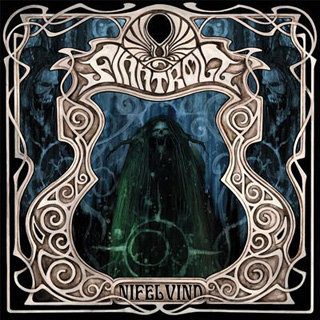
Finntroll – Nifelvind
March 18th, 2010 in CD/DVD, Reviews by Evan Berry
The trolls have returned from the depths of the Finnish swamps, releasing their most wicked and whimsical offering yet. Nifelvind surely packs in more variety and pure insanity into their clearly defined and positively infecting sound. Since their debut, Finntroll has always cleared their own path in the realm of the vast folk metal scene, incorporating their native style of Humppa music into the brutality of heavy metal. Nifelvind continues this sound, but begins to expand more boundaries than any of its predecessors.
On Nifelvind, we begin to hear sounds and influences rarely present on past releases. After a familiar and epic orchestral introduction, the album kicks into the start of the first metal track, ‘Solsagan.’ Immediately, a darker and more death metal influence is obvious, letting the keyboards and catchy sing-along melodies drop out completely. But devoted fans of the old Finntroll need not fret, for as soon as they are missed, the keyboards enter right back in with a bouncy, brass and string filled accompaniment. Once the chorus enters, the classic and contagious melodies of the Finntroll we love are recalled.
Finntroll began to explore the darker side of their music on their previous release, Ur Jordens Djup, and this exploration is continued and expanded on Nifelvind. As keyboardist and lead composer Henri ‘Trollhorn’ Sorvali states: ‘It’s probably the heaviest album we’ve done… I could pretty much safely say this sounds like a meaner and more wicked version of Ur Jordens Djup with an occasional hint of the first album.’ From the furious blast beats of ‘Fornfamnad’ to the pounding double bass of ‘I Tradens Sang,’ Finntroll’s black and death metal influences have never been more prominent.
It’s not only the guitars and drums that lend themselves to the darkness of Nifelvind. The variety of instrumentation is more eclectic than any other Finntroll release. Banjos, marimbas, fiddles, and a collection of various percussion instruments are just a few of the instruments that intertwine themselves inside Finntroll’s wild compositions. Just listen to the spastic ‘Under Bergets Rot’ to hear an incredibly vast array of sound experimentation, and a simply brilliant use of a theremin. It’s tunes like these that prove that Finntroll is able to move out of the all-too-familiar realm of the current folk metal scene, and set themselves apart as an ever-changing and daring act.
This is not to say that the classic Finntroll sound is gone. Just listen to the folky ‘Ett Norrskensdad,’ which recalls the catchy, upbeat tunes from their previous releases ‘Nattfodd’ and ‘Jaktens Tid.’ With their newfound experimentation and improved production, these memorable tunes feel fresh and lively. They even have the guts to strip everything down to Scandinavian-tinged acoustic folk on the evocative ‘Galgasang.’
Nifelvind comes to a close with the epic and truly wicked ‘Drap’ (the Finnish word for ‘Manslaughter’) leaving a cold and twisted feeling in the listener as the album fades out on one of Finntroll’s eeriest riffs. The frivolous and fun atmosphere of Finntroll is certainly still present on Nifelvind, but with an even more devilish and evil atmosphere than ever before. This contrast of light and dark is what makes Nifelvind Finntroll’s most daring and gripping album to date – a disc that sucks its listeners deep into the dark depths of its wickedness.
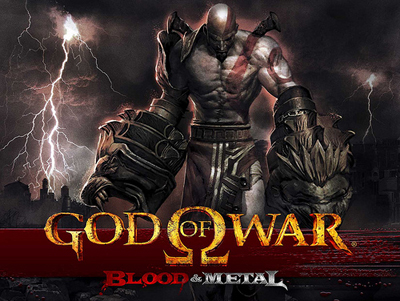
God of War III: Blood & Metal EP
February 13th, 2010 in CD/DVD, Reviews by Chris Dingman
Release Date: March 2, 2010
If any game deserves to have a soundtrack written for it featuring some of today’s leading metal bands, that game is God of War III. Five years ago, the first God of War shattered the gaming world by incorporating everything awesome about action/adventure games into a cinematic gaming experience that pushed the PS2 to its technical limits and, more importantly, allowed players to brutalize their enemies in the most visceral ways imaginable. Now, Sony is poised to release God of War III, the first entry in the series to hit the PS3, and a host of Roadrunner Records artists are ready to reward the series’ dedication to the metal aesthetic by unveiling a six-song set of new music.
Guitar Messenger has had the opportunity to speak with Killswitch Engage, Trivium, Dream Theater and Opeth in the past, and so naturally takes an interest in hearing these bands in the fresh context of a video game album. Each band rises to the occasion in a unique way – some expanding on their recent work, and others taking the opportunity to explore new territory.
Killswitch Engage leads off with ‘My Obsession,’ a track that feels like a natural extension of the recent Killswitch Engage. The song starts with an open string pull-off motif that soon gives way to a riff onslaught worthy of a Kratos battle scene. Adam D. and company have set the bar high for their mixes and overall sound, and they maintain that standard with this track. In the song’s second half, they slow things down and breach new ground by adding a prominent texture that evokes Led Zeppelin’s ‘No Quarter’ – employing what sounds like a Leslie speaker to achieve a similar tremolo effect.
Trivium’s ‘Shattering The Skies Above’ brings things back up to ramming speed, with the blast beats and powerful drumming of recent addition Nick Augusto taking center stage throughout. Matt Heafy continues to improve his vocal chops on this recording, showcasing some of his best clean singing yet. The song features a cool breakdown in the middle section, but the predictable solo section is a missed opportunity to take the song to new heights. Afterwards though, Trivium give their memorable chorus new life by dropping it on two fresh grooves, and they finish strong with a return to the earlier breakdown.
‘Raw Dog’ is Dream Theater’s instrumental offering, and it begins with a grinding, fearsomely down-tuned riff that strays from the band’s usual style. This opening leads into a galloping section of mid-tempo thrash, followed by a riff in what sounds at first like the whole-tone scale (1-2-3-#4-#5-b7), but at times includes a natural 4th and a natural 6th. Petrucci makes good use of this unusual harmony with a memorable ornamented motif. After a ripping trade-off with keyboardist Jordan Rudess, he leads the band through a dizzying groove that harkens back to Systematic Chaos’ ‘The Dark Eternal Night.’ Dream Theater also deserves credit for referencing the God of War score when towards the end, in the reprise of the original riff, Rudess breaks out a choral patch that evokes the grand choruses used by Chris Velasco and other composers in the first game.
‘This Is Madness’ is an opportunity for newcomers Taking Dawn to make their mark on the metal world, which they take advantage of by delivering a ballsy slice of vintage-style metal. Thematically, they draw more on the story of the film 300 than on God of War’s lore, but the vibe is close enough that the song still fits in this collection. Their bridge pulls back on the tempo for a nice triplet feel, and leads into a memorable solo section that closes with bombastic vibrato and furious harmonics.
Opeth takes the biggest risk on the album with ‘Throat Of Winter,’ and listeners are rewarded with a song that’s grounded in a mesmerizing, shifting tonality that is likely to have people reaching for their Led Zeppelin LPs once again. The song favors 12-string acoustics and percussion over distortion and drum kits, and is complemented by a rich production style that incorporates backwards guitar parts and, in a new move for the band, what sounds like lap steel. Keyboardist Per Wiberg also moves into new territory, by contributing moog leads that recall Yes’ Rick Wakeman alongside the usual Opeth textures. The journey ends with a section that lies somewhere between acoustic metal and flamenco – an interesting style which feels like a groovier elaboration on the ending of ‘Burden’ from Watershed.
The fresh-faced Mutiny Within turns out the album’s most epic number, ‘The End’ – which is impressive, considering that it’s also the shortest track of the six. With a jagged arpeggio riff up front during the verse, and prominent but tasteful keyboards in the intro and chorus, Mutiny Within wins points for their strong arrangement ideas and convincing vocals. In a bold production move, the band drops out after the second chorus, leaving a single guitar part buried underneath a filter and a layer of environmental sound effects.
The God of War: Blood & Metal EP is being released both as a standalone digital release, and as a bonus for purchasers of the God of War III Ultimate Edition, which includes other goodies such as an art book, and digital access to music from the games and a full-length documentary tracing the series’ history. God of War has always had tremendous appeal in the metal community, so it’s great to see the franchise capitalizing on that fact by offering something for those many fans. Followers of any of these bands will enjoy hearing the new music on display here.
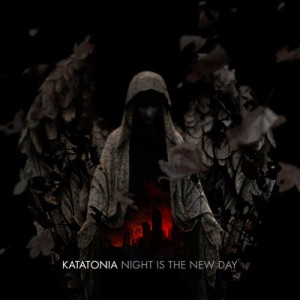
Katatonia – Night Is The New Day
January 14th, 2010 in CD/DVD, Reviews by Chris Dingman
Release Dates: November 2, 2009 (Europe)/November 10, 2009 (North America)
Katatonia have been honing their brooding brand of rock for years. Originally formed as a doom metal band in 1991, the group began to shift direction after several albums as singer Jonas Renske began to employ clean vocals in place of growls. With transitional support from Opeth’s Mikael Akerfeldt, who performed the extreme vocals on 1996’s Brave Murder Day and 1997’s Sounds Of Decay, Katatonia started exploring the bleak, atmospheric recesses of rock – a journey that has led to 2009’s outstanding Night Is The New Day.
From the foreboding opening chords of ‘Forsaker,’ the production on Night Is The New Day distinguishes it from its predecessors. Over the course of five albums on Peaceville Records, Katatonia’s recorded sound has steadily improved, and the rich, spacious soundscape achieved here is a great complement to the band’s melancholic style. The layered and tastefully harmonized vocals are always at the forefront of the mix, and each instrument sits comfortably in a supporting role – easy to identify and smoothly blended into a blanket of reverb and ambience as in the reflective “Inheritance,” and the subdued grooves of ‘Onward Into Battle.’ The sound can be aggressive, too, as on the lead single ‘Day and Then the Shade,’ which opens with a guttural guitar riff supported by hammering drums and a driving synth.
As terrific as the album sounds, the real success of Night Is The New Day can be attributed to its consistency – the band explore metal, folk, and ambient electronic all while maintaining a beautifully bleak mood. Most albums with such a pervasive musical and lyrical theme fail to deliver distinct songs, but Katatonia craft such strong hooks that the insistent ‘The Longest Year’ and the sorrowful ‘The Promise Of Deceit’ become lodged in memory after the first listen. Although guitarist Anders Nyström’s playing rarely takes center stage, he guides the songs with propulsive riffs that alternately batter and jangle, and lays back masterfully with lush chord swells – often during the course of a single track, as in ‘Liberation.’
Collaborator Frank Default, whose tasteful textures and synthesized beats help Katatonia achieve this album’s intimate atmosphere, makes only one misstep when his string samples, which sound excellent in a full band mix, take center stage in the middle section of ‘Inheritance.’ In contrast, his parts during the quiet verse of ‘Nephilim’ keep the song eerie throughout by allowing the dissonances of the chorus to softly seep into the seams of the track. Elsewhere, he adds electronic grooves to the verse of ‘The Longest Year’ and shimmering flourishes to the hammering riffs in the chorus of ‘Forsaker’ to great effect.
The Vinyl and Swedish CD Editions of the album contain the bonus track ‘Ashen,’ which sits between ‘Day and Then the Shade’ and the closing ‘Departer,’ and adds so much energy to the flow of the album that its absence in other versions is a definite loss. With a disorienting verse, punishing pre-chorus and anthemic chorus, ‘Ashen’ is a standout track that deserves to be heard by Katatonia fans worldwide. It is a testament to the strength of the album that even without that track, it still feels like a complete journey. Those who appreciate a well-guided tour of the darker side of emotion will enjoy Night Is The New Day.
Overall: 5/5
Richie Kotzen – Peace Sign
November 10th, 2009 in CD/DVD, Reviews by Chris Dingman
Release Date: September 9, 2009
Richie Kotzen’s latest offering, Peace Sign, once again showcases the distinctive blend of styles that has won the virtuoso guitarist fans worldwide. The twelve-track album is divided into three equal sections: rock, soul/funk, and pop balladry. Because of the album’s track sequencing, it starts very strong, though the flow drags during the four ballads that close the disc. Kotzen’s choice of tones further distinguishes the styles, from the thunderous single-coil sound that opens ‘Long Way From Home’ and the angry saturation of his ‘My Messiah’ rhythms, to the buzzy riff tones on ‘We’re All Famous’ and ‘Your Entertainer.’ Acoustic guitar is the most obvious addition to his sound on the ballads, and Kotzen complements it with jangly rhythm tones on ‘Catch Up To Me’ and warm leads on ‘Larger Than Life.’
Kotzen’s songwriting shines on tracks like the driving opener ‘My Messiah,’ the insistently funky ‘Your Entertainer’ and the soul-bearing ‘Catch Up To Me,’ where his impassioned vocals sell the song’s confessional lyrics. His guitar playing strikes a great balance between soulful phrasing and fretboard melting in the solos on ‘Best Of Times’ and ‘Lie To Me,’ where he finds the best pockets in the groove to start phrases and dig into bends. Kotzen takes his most interesting solo on the album during ‘You Got Me’ – using a less saturated, twangier tone, he slips in and around the beat with his most lyrical playing, making colorful note choices and saving a brilliant blast of speed for the final phrase.
Overall: 4/5
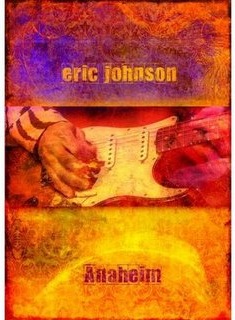
Eric Johnson – Anaheim DVD
March 18th, 2009 in CD/DVD, Reviews by Chris DingmanRelease Date : November 11, 2008

As any Eric Johnson fan knows, a new release from the legendary Texan is cause for celebration. A guitarist known for his lush array of tones as much as for his articulate, fretboard-scaling lines, Johnson also possesses one of the most discerning ears in the business, and as his own producer chooses only the best of his material to release to the public. This uncompromising standard has applied not only to Johnson’s studio albums, but to his live video releases, as well – his famous 1988 appearance on PBS’ Austin City Limits was released on home video as recently as 2005. However, with his latest release, Anaheim, filmed for HDNet as recently as May 3 of 2006, he seems to have found a way to accelerate his editing without sacrificing audio quality.
After the mesmerizing animated menu intro, Anaheim opens with a roar of hammering Hendrix-like fuzz before Johnson kicks his band into the driving ‘Summer Jam.’ The trio of Johnson on guitar, Chris Maresh on bass and Tommy Taylor on drums sound huge from the start and the shifting, insistent groove of ‘Summer Jam’ makes for an energizing opener.
As the first song ends, they waste no time in introducing a heavily reworked cover of Bob Dylan’s ‘My Back Pages,’ which is recognizable only by traces of the original lyrics and vocal melodies. Johnson’s interpretation features a host of terrific chord voicings underneath the verses, and some interesting re-arrangements of the song form – including the transformation of one verse into a bridge and the addition of blazing solo sections in-between each verse. Johnson gives a strong vocal performance on this track, and Taylor’s drumming is furious and rock steady from the first kick.
Other highlights include an inspired performance of the anthemic ‘Trademark’ that features a few of Johnson’s amazing clean tones, as well as some of his more surprising playing – he uses a few chromatic approach chords throughout the song that most fans won’t be expecting, as well as a completely outside line in the solo that, whether intentionally or not, he plays with such confidence and resolves so cleanly that it simply works. Maresh’s bass tone is rich and ideal for this track, especially when he kicks in the distortion and heads over to his amp to ignite some righteous feedback.
The bubbly country western tune ‘On The Way To Love’ highlights even more sparkling Strat cleans, and the calmer guitars give Taylor room to drive the tune with the sound of his tightly tuned kit. Another pleasant surprise is the Maresh-penned rock/fusion epic ‘Rocktopus.’ Johnson’s riffs have never sounded as heavy as they do on this track, and the trio sound monstrously tight through the song’s many changes of pace as well as its groovier moments.
Anaheim also shows a very different side of Johnson than has been seen on previous concert videos – a playful side that seems to be having a terrific amount of fun on stage. This energetic stage presence is especially evident in Johnson’s rocked-out cover of The Monkees’ ‘A Little Bit Me, A Little Bit You,’ where Johnson runs around, grinning, and dances over to his amp to produce feedback. Pushing his boundaries one step farther, Johnson sets down his Strat, and begins the extended intro to his iconic ‘Cliffs Of Dover’ on a Gibson SG. The lush, voice-led chords in the first few minutes of the solo sound amazing, and the novelty of seeing him play ‘Cliffs Of Dover’ on a guitar besides his Strat only becomes more fascinating as he builds anticipation for the song’s opening runs. When he finally does, his tone is searing and his performance, from the famous melody to the blistering solo, is inspiring.
The DVD isn’t without its faults, though. Though filmed in HD and presented in a widescreen ratio, the video on the disc is noticeably compressed and non-anamorphic, so on widescreen displays the picture only takes up the width of a standard 4:3 display with black bars on the sides as well as the top and bottom. This can be remedied by using the zoom feature on your monitor or DVD player, but it results in some image distortion, which is regrettable, since the concert is so nicely filmed. Fortunately, Anaheim sounds fantastic – the mix is rich and clear. Rarely do a trio take up as much sonic space as this one – with Johnson’s broad chord voicings, Maresh’s towering and sometimes aggressive tone, and Taylor’s relentlessly powerful drumming, the sound of a keyboard or a second guitar is rarely missed throughout this terrific set.
The set is also short, coming in at around 50 minutes, and while it stands up well to multiple viewings, it would have been nice to get a longer performance. To give Eric Johnson fans a little more for their money, the DVD also includes part of a nice Harmony Central interview with Johnson, and three songs shot on his Acoustic Guitar and Piano tour. Johnson proves himself to be an accomplished pianist by accompanying himself on a jazzy version of Hendrix’s ‘The Wind Cries Mary,’ and running through a stripped-down version of his own ballad, the beautiful ‘Song For Lynette.’ Nestled between those two is a solo acoustic guitar performance of Johnson’s rustic ‘Song For George.’ These songs are filmed with less glamour than the well-produced main show, but that does little to detract from the intimate charm of these one-man arrangements.
Despite some technical flaws, Anaheim is well worth purchasing for fans of Eric Johnson’s eclectic music, as well as for guitar buffs eager for another opportunity to watch his incredible fingers in action. Like Austin City Limits before it, the camera work here affords the viewer plenty of opportunities to study Johnson’s unique style, though it will take many plays to absorb everything he plays. Anaheim is a great document of a vital and distinctive artist who is trying new things, and who seems to love his craft now more than ever.
Overall: 4.5/5
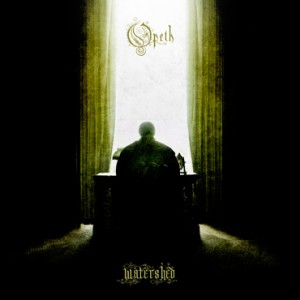
Opeth – Watershed
July 16th, 2008 in CD/DVD, Reviews by Chris Dingman
Release Date: June 3, 2008
With each album Opeth have released since their first album in 1995, they have been perfecting their combination of extreme metal’s brutality and progressive rock’s complex song structures and harmonies. Singer, guitarist, and mastermind Mikael Åkerfeldt’s band first attracted the attention of the broader metal community with 2001’s Blackwater Park, which benefited from the producing expertise of Porcupine Tree’s Steven Wilson – who finally gave Opeth’s rich music the sonic power it deserved. With Wilson’s help, Opeth explored and expanded the mellower side of their sound on 2003’s Damnation, after becoming heavier than ever on parts of 2002’s Deliverance. On 2005’s Ghost Reveries, with the addition of keyboardist Per Wiberg, Opeth incorporated the newly improved extremes of their style into a well-realized whole.
On Watershed, Opeth take the path they traveled on Ghost Reveries and stretch it out in every direction – further integrating keyboardist Per Wiberg, as well as two members who have joined since the last album: guitarist Fredrik Åkesson and drummer Martin Axenrot. Additionally, they incorporate small woodwind and string sections into the music – a decision that mirrors the unorthodox approach to songwriting Opeth take on Watershed, the band’s most diverse and experimental album yet.
‘Coil’ immediately draws you into Opeth’s world with a series of haunting, softly dissonant chords that set the stage for Åkerfeldt’s mournful vocals. Spicing up the main theme of this short opener are some beautiful bass lines courtesy of Martin Mendez, and a striking wind arrangement that brightens the song’s chorus. Answering Åkerfeldt’s verse is a beautiful female voice provided by Axenrot’s girlfriend Nathalie Lorichs – another surprising first for the band, who until now have only featured their former producer Steven Wilson as a guest vocalist.
‘Heir Apparent’ opens like a slow-groove version of ‘Deliverance’ – a staple of Opeth’s live shows and the most mosh-inspiring song the band has ever written. This song features one of the most intricate and fist-pumping riffs Opeth have ever devised, which serves as a backdrop for both the furious drumming of Axenrot as well as a tastefully demented solo from Åkesson. The low E string has never sounded heavier. There are several quiet sections in ‘Heir Apparent,’ but they feel less like a break from the violence and more like the soundtrack to a psychotic nightmare. Just when you think that the song has escalated to its frenzied peak, it gives way to a majestic groove featuring one of Åkerfeldt’s most somber and memorable melodies.
‘Lotus Eater’ begins with a jazzy bit of humming, and becomes more unusual once the metal kicks in. Featuring a dreamlike melody that is violently supported by Axenrot’s blast beats, this recurring riff is not the strangest part of the song. Nor is the jarring clean section that follows, which feels like a brief but disturbing descent into madness. No, the strangest section is what can best be described as creepy progressive funk featuring Wiberg – it’s weird, and it’s grooving, too. ‘Lotus Eater’ covers a lot of new ground in just under nine minutes, though it also features some vintage Opeth grooves and a soaring Åkerfeldt solo. Most importantly, everything in the song fits and flows surprisingly well.
‘Burden’ feels like the soft spot of the album from Wiberg’s delicate first chords, which are soon joined by a soft Åkerfeldt solo that would have been at home in Damnation’s introspective ‘Hope Leaves.’ Just when it seems that Opeth are about to revisit the sad beauty of that album, Åkerfeldt kicks in with his strongest clean vocals to date, and Opeth’s first rock power ballad begins in earnest. The song plays out the way you’d expect an Opeth power ballad to, as strange as that feels to say – the verse winds through a melancholy chord progression, and the chorus is punctuated by dramatic Åkesson mini-solos. Breaking up the familiar form are some stellar solo sections: first a positively rocking organ solo from Wiberg, and then an exciting trade-off between Åkerfeldt and Åkesson that ends in a dual-guitar harmony that’s vintage Åkerfeldt. The ending, though, is where ‘Burden’ really feels like a part of Watershed. It starts out nicely enough with some pretty acoustic guitar work, but quickly becomes a showcase for some of the band’s most unusual alternate tunings.
‘Porcelain Heart’ works best as a showcase for Axenrot’s diverse drumming. His playing on the opening theme moves through several distinct stages, and does a great job of building tension. The galloping riff that comes in midway through the song develops nicely with harmonized vocals and great drumming from Axenrot, but it feels out of place with the opening section and the eerie acoustic verses. Both times that the riff appears in the song, the transitions around it feel unnatural – which is surprising coming from a band that normally does such a great job of blending drastically different elements into a single song. It’s particularly unfortunate that the parts don’t mesh, as most of them are terrific on their own.
‘Hessian Peel’ brings back the excellent dynamic flow that Opeth fans have come to expect. In less than twelve minutes, the song moves smoothly between upbeat sections of sorrowful acoustic guitars and dissonant onslaughts of screaming, and features a grooving acoustic riff that’s accompanied by clever drumming and a great string arrangement.The final moments of the track are some of the darkest and most unsettling yet on an album full of surprises.
‘Hex Omega’ steals the show by concisely combining the experimental spirit of Watershed with Opeth’s riff-oriented songwriting style. As a result, the song is filled with haunting vocal melodies and fantastic riffs, both delivered with an epic sense of atmosphere. The trudging riff that closes the song is a dramatic finish for the most progressive album Opeth have recorded yet.
As always, Åkerfeldt’s vision ensures that the music flows together to form a coherent album. As a whole, Watershed leaves you feeling satisfied, but the individual songs don’t always feel as connected as they have on past efforts. The album’s shorter and less frequently repeated song sections are partly responsible for making the tracks harder to grab onto, and it makes the album less focused on groove than past efforts have been. The moments that do linger after the first listen are infectious, particularly those in ‘Heir Apparent, ‘Hex Omega,’ and the sweeping ‘Burden,’ and listeners who invest time in Watershed will be rewarded with a musically rich album. It’s great to see a band with a winning formula continue to mix it up, and Opeth have never sounded fresher or more daring than they do here. In fact, on this album even more than on Ghost Reveries, the band lean more towards progressive rock than they do towards metal, which makes for some impressive song structures and many bizarre moments that test the listener’s grasp on sanity.
All of this experimentation makes Watershed an exciting album for Opeth fans – as well as prog fans with a stomach for heaviness, and metal fans with a taste for the unusual. Opeth’s track record of persistently pushing boundaries suggests that they haven’t made their ultimate album yet, which means that their listeners have a lot to look forward to. Underneath the new flavors, the beauty and brutality that have always driven Opeth’s sound live on in Watershed.
Overall: 4.5/5
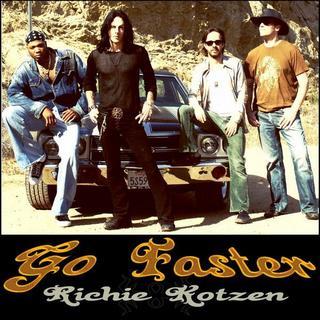
Richie Kotzen – Go Faster
May 19th, 2008 in CD/DVD, Reviews by Chris Dingman
Release Date: August 21, 2007
Former Poison and Mr. Big guitarist Richie Kotzen has matured gracefully in the years since he entered the scene in 1989 as a budding six-string virtuoso on Mike Varney’s Shrapnel Records. Since adopting Fender instruments in the early 90’s, Kotzen has developed two signature guitars with Fender Japan that consistently rank amongst their best-selling models. Kotzen has been pumping out quality solo material and playing to adoring crowds worldwide for years.
Kotzen’s latest offering (called Go Faster here in the US, and Return Of Mother Head’s Family Reunion in the rest of the world) is a groove-infused celebration of rock music. While maintaining a contemporary edge, Go Faster recalls the classic rock of the 60’s and 70’s, and also draws inspiration from vintage soul and funk – check out the infectious vocal refrain in ‘Faith’ and the wah-drenched background guitars in ‘You Know That.’ Whatever styles Kotzen brings into a particular track, he maintains a distinctive rock attitude in his delivery of every song.
Go Faster boasts a good balance of ripping tracks like the title track and ‘Feed My Head,’ as well as slower tunes. Of the ballads, ‘Chase It’ stands out as a tremendously catchy composition, tailored to a radio format by joining gorgeous melodies with reflective lyrics and a tasteful arrangement that builds to a powerful peak. His compositional skills shine in bluesy rock songs like ‘Bad Things’ and ‘Do It To Yourself,’ where he develops his catchy themes with distinctive sections that flow fluidly into one another. Song after song, the album contains riffs that grab you and melodies that keep swimming around your head hours after you hear them.
From the album’s opening track to its final moments, Kotzen sings with authority. Kotzen brings bluesy inflections to his vocal melodies in songs like ‘Feed My Head,’ and an insistent wail to soulful rockers like ‘You Know That.’ His vocal lines are memorable and delivered with fire – something that is often missing in guitarists of his caliber who take the mic.
The guitar tones all over Go Faster proudly scream ‘single coil!’ courtesy of Kotzen’s signature Strat and Tele. He coaxes lead tones out of them that serve each musical setting – from the brutal lines of ‘Bad Things’ to the buttery solo in ‘Fooled Again.’ His rhythm tone complements his shimmering chord work, as well as his more frequent guttural riffage.
He infuses his playing with as much inflection as he does his vocals, and anchors it with a rock solid groove. Kotzen’s solos are the only inconsistent element here – he sometimes comes out of the gate blazing and slows down only briefly for a bend, which prevents songs like ‘Feed My Head’ from rocking as thoroughly as they could. Other times, as in ‘Dust,’ his solos lock right into the groove from the start and progress naturally towards a satisfying finish.
The performances and recordings of every player involved are tight and crisp. Every instrument holds its own ground in the mix of Go Faster, and fuels the winding vibes that make up the album. Kotzen involved the band in the jams that produced the final cuts of the album, and it shows in places like the down-and-dirty verse of ‘Bad Things,’ where the rhythm section sets off Kotzen’s riff with some very hip accents. The vocals stand above the rest of the mix, followed closely by the lead guitar – which is loud enough to command your attention without masking the performances of the rest of the band. Overall, this an excellent rock album that showcases strong songs and striking vocals as much as it highlights Kotzen’s virtuosic guitar work.
Highlights
- Kotzen’s soaring falsetto in the chorus of ‘Go Faster’
- The addicting pre-chorus and chorus of ‘Fooled Again’
- Kotzen’s sharp phrasing and incendiary rock fire in ‘Fooled Again’ (5:26 – 6:19)
- The trudging groove that fuels the intro and verse of ‘Dust’
- The gnarly dyads that open the ‘Dust’ solo, and its twisting wah lines (3:24)
- The push-pull interplay of the bass drum and guitar in ‘Do It To Yourself’s verse
- Every emotive minute of the radio-ready ballad ‘Chase It’
- ‘Feed My Head’s escalating intro riff
Overall: 4.5/5
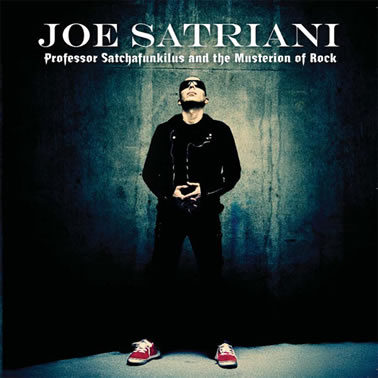
Joe Satriani – Professor Satchafunkilus and the Musterion of Rock
April 10th, 2008 in CD/DVD, Reviews by Chris Dingman
Release Date: April 1, 2008
Joe Satriani has been in the business of making memorable instrumental guitar rock for more than two decades. After helping to bring the genre into the mainstream in the late 80’s with his seminal 1987 album Surfing with the Alien, Satriani has taken detours to fuse numerous other genres with his core style. For instance, he introduced some bluesy fusion into his sound on his self-titled 1995 album, as well as elements of electronic music on the unexpected Engines Of Creation in 2000.
Throughout his experimentation, he has always retained a distinctive voice both as a guitarist and a composer, thanks to his expressive phrasing and keen ear for melody. Since 2002’s Strange Beautiful Music, Satriani has been using a straightforward rock format as the foundation to explore vintage American and sometimes Eastern influences.
On his boldly titled new disc Professor Satchafunkilus and the Musterion of Rock, Satriani continues in this vein for the most part. As always, he brings in several well-developed ballads, including the introspective “Revelation,” which contains one of the album’s most riveting and melodic solos. He rocks out in his unique manner – laying down monster riffs and supplementing them with melodies that navigate their way through intriguing chord progressions as in ‘Overdriver’ or linger over static blues-rock grooves like those in “I Just Wanna Rock.”
Satriani does explore some exciting new territory on “Asik Vaysel,” a tribute to the departed Turkish saz (a native four-stringed instrument) player of the same name. In attempting to imitate Vaysel’s playing, Satriani employs an extremely light touch with both his fretting and his picking hand. His approach results in some of the smoothest guitar tones ever heard, from a man internationally regarded for his distinctive legato techniques.
As adventurous as his chord structures and melodies become, Satriani centers many of his solos around pentatonic scales, supplementing them with accents or runs that connect his lines to the harmony of the song. While he does this very well, it does at times prevent him from taking full advantage of the unusual tonalities that he explores in his compositions, such as the Hungarian Minor context of “Musterion.” The opening to “Andalusia,” however, defies this trend, and stands out because of it. His chops throughout are in peak form, showcasing his flair for melding chunky blues phrases with slippery scalar lines.
Satriani’s albums have always sounded good for their time, and the clear production of Professor Satchafunkilus and the Musterion of Rock (handled this time around by John Cuniberti with Satriani) measures up well against his other recent efforts. In a genre where funds are often tight and engineering is often shortchanged, Satriani’s tones cut through the rounded bass guitar and tight drums of his rhythm section. The quiet blend of percussion and sorrowful acoustic lead work at the beginning of album closer ‘Andalusia’ sounds just as sonically rich as the rest of the album – but more impressive still is the smooth shift in dynamics when the drums kick in and Satriani unleashes the dark riffing that anchors the rest of the song.
Professor Satchafunkilus and the Musterion of Rock stays true to Satriani’s roots and proves to be a solid addition to his impressive catalogue. His strength as a musician continues to be his restraint as a guitarist. Fans of his recent work will certainly enjoy the clever guitar rock that he once again delivers on his latest album.
Highlights
- Satriani’s wild, fuzz-drenched solo in ‘Overdriver’
- The bouncy melodies of the playful funk-fest ‘Professor Satchafunkilus’
- The searching pre-chorus and cathartic chorus of ‘Revelation’
- Satriani’s wrenching solo over the ‘Revelation’ outro
- The slinky organ vibes that drive the cleverly titled ‘Diddle-Y-A-Doo-Dat’
- The captivating pedal tone melody that opens ‘Asik Vaysel’
- Satriani’s lush acoustic solo in the first two minutes of ‘Andalusia’
- The alternation between aggressive scale bursts, searing slow-release bends and furious whammy bar thrashings in Satriani’s solo (4:51 – 6:01) in ‘Andalusia’
Overall: 4/5
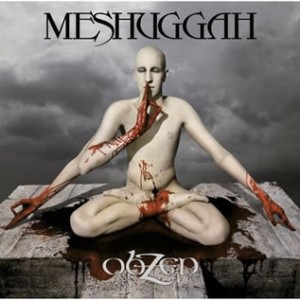
Meshuggah – obZen
February 20th, 2008 in CD/DVD, Reviews by Charlie Shaughnessy
Release Date: March 11th, 2008
The little preview I got of “Bleed” a few weeks prior to receiving my promo copy of obZen was not enough to prepare me for the musical density of Meshuggah’s latest thrill-ride. It’s quite a task to accurately describe the musical content of a group like this. To say the least, fans will be pleased to know that the band has stuck to their sound and even incorporated some of their roots in this new album.
Though by this point most of us are so used to the crushing sound of eight-string guitars methodically playing in sync with mind-bending drum patterns, there are hints of some early “thrash” Meshuggah garnishing the material on this album. I use the term loosely, because Meshuggah sounds almost nothing like a thrash metal band. Compare the term to some of the riffs in Destroy, Erase Improve and None to get a feel for what I’m speaking of.
The opening track “Combustion” grants us a fast-paced introduction to obZen. Most of the track ditches the layered odd rhythms between the guitars and drums, which have become so common to Meshuggah’s writing style in favor of a straight-ahead approach. The 3-feel intro “Dancers To A Discordant System” really feels like what the title suggests. Similarly, the intro to “Pineal Gland Optics” features the guitars and drums performing a clever play off one another. Drummer Thomas Haake’s time feel is a lot less rigid than it was on Catch 33, most likely due to the drums being recorded live as opposed to sequenced.
The guitar tones have improved since Catch 33, and the drums sound better since it’s a real performance. The band is sticking to Line 6 gear, and they use it to the full potential for the most part. Some of their “semi distorted” sounds they get (such as the sound used at 0:15 in “Dancers To A Discordant System”) are a bit shrill, but everything else is brutal and heavy enough to accurately complement the music. The solo tones are rather quiet in the mix, and guitarist Fredrik Thordendal could be heard more on this album.
The performances on obZen are extremely tight and well-produced, especially considering how complex the music is. It’s always interesting when the band breaks to a soundscape or a guitar solo because of the exotic and contrasting texture it creates with the violent nature of Jens Kidman, so I would’ve loved to hear more. Like the rest of the band, Fredrik has firmly established his “sound” in terms of soloing. Some of his solos are full of his signature tapping licks, while others feature Holdsworth-like phrasing. His signature breath controller may be going through some technical difficulties, because it seems to be MIA for this album. Some of his coolest guitar sounds have been made with that device, so I hope we see it on their next work.
Overall, the new Meshuggah disc is violently heavy, full of groove, and thrashier than most previous discs. As far as material is concerned, it’s hard to separate this album as anything significantly diverse in comparison to the rest of their catalog, but having said that, more Meshuggah is always good Meshuggah, and it’s great to hear how they are developing as players.
Highlights
- The verse riff to “Electric Red” (0:26)
- The soundscape and guitar solo to “Bleed” (4:10)
- “Lethargica” outro (4:35)
- Fredrik’s tapping solo to “This Spiteful Snake” (3:15)
- “Pravus” intro
- The guitar intro to “Dancers To A Discordant System” (0:15)
- Guitar solo in “Dancers To A Discordant System” (6:28) and the heavy modal riff right afterwards.
Overall: 4/5
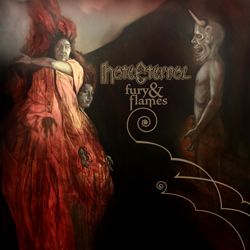
Hate Eternal – Fury And Flames
February 19th, 2008 in CD/DVD, Reviews by Jimmy Gately

Release Date: February 19th, 2008
Hate Eternal have once again proven that they are the King of all Kings. After facing several dilemmas last year including the departure of drummer Derek Roddy, the possibility of canceling a tour, and the passing of fellow friend and ex-band mate Jared Anderson, guitarist/vocalist Erik Rutan has returned with a new line up, a new label and a new album, entitled Fury & Flames. This album clocks in at 40 minutes even and it never stops.
Musically, the album is vicious, brutal and relentless. Rutan is a master of dissonant and twisted melodies yielding them in both somber and dark atmospheres. Lyrically, as he has before, he writes in a more aggressive and hate-filled mindset, picking topics in philosophy, religion, and war. Rutan sounds like an absolute monster on this album, very much sounding inhuman.
The addition of Shaune Kelley makes them sound twice as loud and provides great tandem soloing. The solos throughout the album fit perfectly whether it is Slayer-like shredding or sinister sounding melodic lines. Alex Webster, as always, lays down some of the best bass lines in death metal and if listened to carefully, can be picked up in various parts of songs. The drumming on the album, now provided by Jade Simonetto, is nothing short of recognition. He has incredible double bass and hands and deserves to be part of the lineage of drummers that have played with Hate Eternal which includes Tim Yeung, Derek Roddy, Kevin Talley, and Reno Kiilerich, too name a few.
The album opens up with a track called “Hell Envenom” which takes me back to their King Of All Kings album. The song begins with Rutan screaming with a heavy echo effect at which the band enters with a wall of cacophony, a creating a ominous and eerie vibe. The band then stops for Erik to roar “Hell Envenom!” and the blasting begins. This is one of my favorite tracks off the album. Other tracks such as “Whom Gods May Destroy” and “The Funerary March” follow in that same style of just pure brutality.
Several tracks on the album have some surprising turns, one being a song called “Bringer of Storms.” Although the song does contain blasting, it still maintains a slow half-time feel. It is a fairly melodic song more geared towards generating a particular feel, rather than the more dissonant riffing in the aforementioned tracks. It does contain one of the heaviest moments on the album with Rutan screaming, “Hail!” over and over again.
One of the most surprising moments on the album is a track called “Fury Within”. It opens with a jarring riff with a heavy rhythm motif, but the drums are playing a more groove-oriented style, rather than blasting away. It even contains, for lack of a better term, a sort of breakdown-esque drum part near the end of the song. This song, although not necessarily groundbreaking, will definitely catch the ears of Hate Eternal fans.
Overall, this album is amazing. The production is excellent considering it is recorded on a two-inch analog machine that Rutan has had since his Morbid Angel days. Despite all the obstacles they faced at the end of 2007, Hate Eternal has found new strength and will continue its devastation in the death metal community.
Highlights
- Hell Envenom
- Para Bellum
- Bringer Of Storms
- Fury Within
- Tombeau (Le Tombeau De La Fureur et Des Flammes)
Overall: 4.5/5
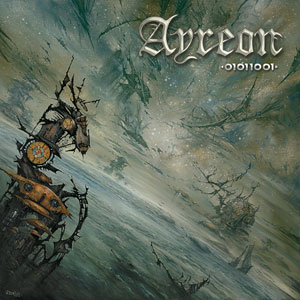
Ayreon – 01011001
January 7th, 2008 in CD/DVD, Reviews by Charlie Shaughnessy
Release Date; Jan. 29th, 2008
Arjen Lucassen never ceases to amaze, and nothing changes with the latest Ayreon masterpiece. Ayreon – 01011001 (or Y) is split up into two parts – Planet Y and Earth. Lyrically, the album is a bit less straightforward than his previous work, The Human Equation. While it was pretty obvious what the story behind THE was, it may be a bit hard for the listener to break through the density of Y if enjoyment was found in THE’s lyrical style, although this method gives Arjen a chance to be a bit more playful and artistic with the way he uses words.
I have mixed feelings about the compositions on Planet Y. As an album, it’s a collection of very dark material, probably the darkest writing of Arjen’s career. It’s the first time I’ve heard a vocoder being used in his material, and where it’s used it fits very well. I’m not sure that many people will appreciate some of the more experimental moments on the album: the doom-pop feel of ‘Connect The Dots’, the cheesy pirate-dance theme in ‘The Truth Is In Here’ (although I think this is typical of Arjen), also some of the vocal moments on ‘E=MC2′ may be a bit too much for some listeners. At the same time, Arjen has written some of the best material of his career. ‘Beneath The Waves’ is simply stunning songwriting, ‘The Fifth’ and ‘Sixth Extinctions’ are both masterpieces in their own right, and ‘Walking Dreams’ is one of the most relaxed and cohesive pieces on the album.
Arjen always seems to get top-notch performances from his vocal guests. I don’t think I’ve ever heard Daniel Gildenlow perform the way he does on Y (compare this to James LaBrie’s performance on THE). It’s disappointing that Ty Tabor’s sole performance is on ‘Connect The Dots’, although I think his voice fits well for the moment. Tom Englund sounds fantastic and his voice fits well for the material, as do all of the guest singers. As always, Arjen’s guitar playing is both tasteful and technical. I was surprised when I saw Tomas Bodin’s name on the guest player list – his keyboard solo on ‘Waking Dreams’ was very appropriate for the music. The album sounds great, as all of Arjen’s albums do. He’s got a very unique and tasteful mixing style that fits very appropriately with the music.
Highlights
- The acoustic interlude on ‘Age of Shadows’ (beautiful use of the vocoder)
- Guitar solo on ‘Beneath The Waves’
- ‘Web of Lies’ – beautiful acoustic guitar playing and writing
- 6:10 of ‘The Fifth Extinction’ and the subsequent string break at 7:50
- Keyboard solo on ‘Waking Dreams’
- Arjen’s vocal performance on ‘The Truth is In Here’
- Violin solo and flute solo on ‘River of Time’
- Michael Romeo’s guitar solo on ‘E=MC2′
- Part C of ‘The Sixth Extinction (2085)’ – 3:20
Overall: 4.5/5
A must for any Ayreon fan, but ‘Connect The Dots’ takes a lot away from the dark, lyrically dense feel of the album. The lyric material is almost too dense at times, and probably too cheesy for most listeners, even of this particular style. That being said, fans of most of the guest singers’ bands (ie, Blind Guardian) are bound to fall in love with this album, and people who loved THE have got to pick this one up!