
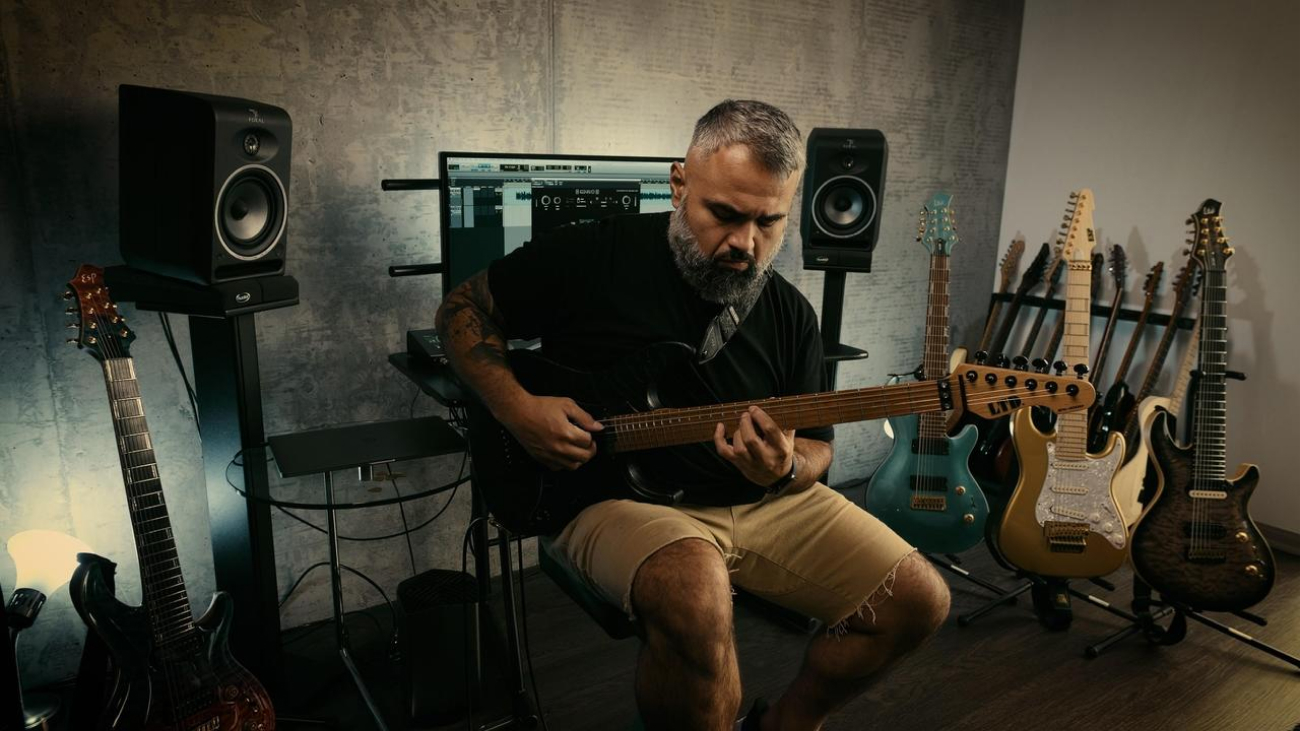

Putting Jazz In Metal With Ever Forthright
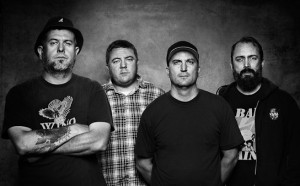
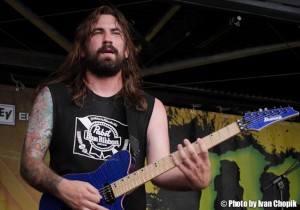
February 17th, 2011 by Nicholas LlerandiWelcome to Guitar Messenger! I’m Nick from the band Ever Forthright. Today we’re going to use excerpts from two of our recent songs, ‘The Counter Shift‘ and ‘Dispose Of Your Optimism‘, to demonstrate how you can use jazz harmony and concepts in modern progressive metal. All examples are played on an 8-string in standard tuning: F# B E A D G B E
Passing Tones – The Counter Shift 1:43:
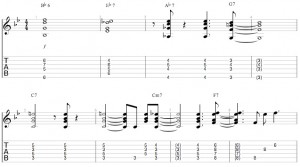
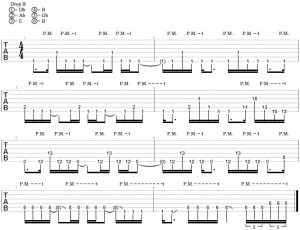
This section is a great example of using passing tones (labeled PT in the tabs) to connect chords in a riff or progression. This section is pretty much a ‘techy’ take on the same progression that happens in this song at 3:15. It’s based around a progression that was really jazz, or even hip-hop/R&B influenced (especially the Dbmin7b6 to the Ebmin7b6). With the exception of the first two chords (Gmin to Ebmaj), this progression is very modal.
This riff also uses several passing tones in some of the lines connecting the chords – in other words, notes that normally don’t apply to that chord or its corresponding scale. A good way to apply this method is to resolve chord tones on downbeats and have ‘wrong notes’/passing tones on off beats. It’s a great way to break away from the usual scales and apply all 12 notes to any chord.
Audio clip: Adobe Flash Player (version 9 or above) is required to play this audio clip. Download the latest version here. You also need to have JavaScript enabled in your browser.

Modal Tapping – The Counter Shift 3:15:
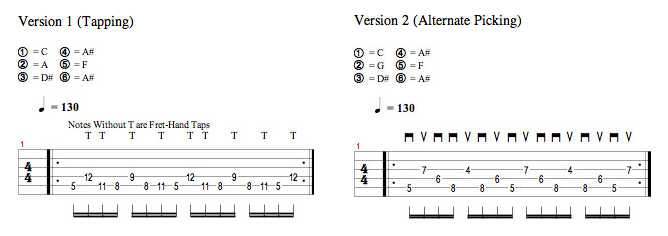
In this example, we learn to apply multi-finger tapping to a modal progression. This is the same progression that recurs throughout the song, but this time every chord is given a chance to stand out. The tapping in this section applies multi-finger tapping with the right hand, and pulling off to open strings with the left hand.
Those two techniques combined give the line a fairly large range of notes and also a large range of timbre, because tapping, picking, hammering on, pulling off, hammering on from an open string, pulling off to an open string, etc. all create different timbres. What I really like about this line is that it applies those different techniques and sounds to a modal progression instead of your standard eight bars of A minor.
Audio clip: Adobe Flash Player (version 9 or above) is required to play this audio clip. Download the latest version here. You also need to have JavaScript enabled in your browser.

Open String Diminished – Dispose of Your Optimism 1:54:
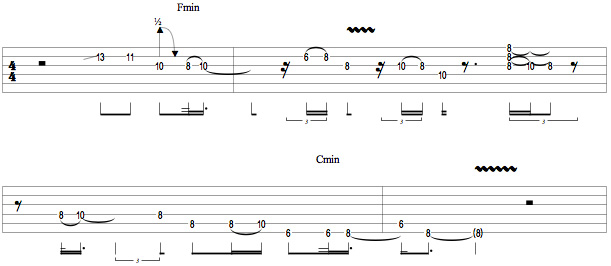
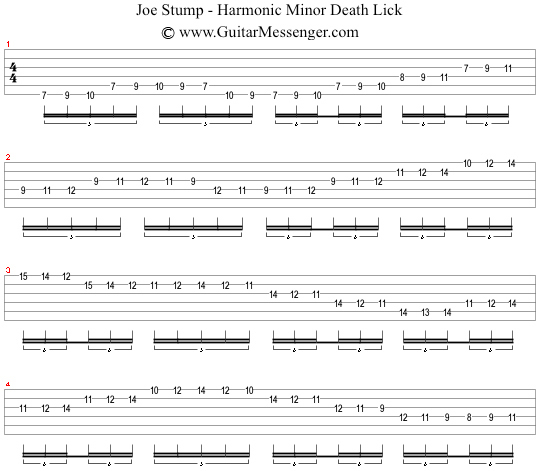
Here’s a long way of playing ‘V-I’ using a diminished chord. Having a diminished chord resolve up a half step is probably the most used progression in music, so harmonically nothing crazy is going on here. What I like about this riff is the chaotic use of the B whole-half diminished scale using open strings. On an 8-string guitar, with the exception of the open F# and A strings, all of the open strings are in this scale (I use the open A string in this riff anyway. Why?…. Why not?).
Also, In the following chord (Cmajor7#11), all of the strings including the F# and A are in the C Lydian scale. So this riff was a perfect opportunity to go open-string crazy. I like to use open strings because they have a cool timbre – six out of the twelve possible notes are incredibly easy to get to (on an 8-string), and they allow guitarists to play lines and licks that would be impossible on most other instruments.
Audio clip: Adobe Flash Player (version 9 or above) is required to play this audio clip. Download the latest version here. You also need to have JavaScript enabled in your browser.

Minor-Major-Minor – Dispose of Your Optimism 6:50:
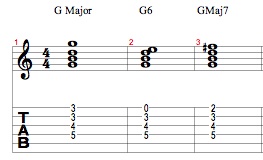
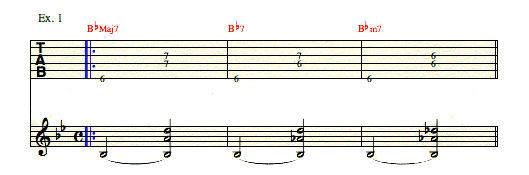
Here’s a way to add interest to the classic technique of going from minor to major and back again. This is definitely one of my favorite lines, and thankfully it’s super easy to play. It sits right on top of the chorus, which is Bmin9add11-Bmaj9-Bmin7b6. That sounds like a lot, but it’s just a fancy way of saying Minor-Major-Minor. Even though the guitar voicings are doing their own thing, it’s all just sitting on a B pedal tone.
There are no sixths played in the first minor chord, so there is nothing that places it in either the Aeolian mode or Dorian Mode (I consider Phrygian to be a separate type of sound, although technically it is minor) and there are no elevenths played on the major chord so there is nothing defining it as Lydian or Ionian. This is why I like the resolution so much on that last minor chord – it has that b6 in it and really gives off a heavy vibe. I didn’t put the b6 in the tapping line because I feel it would have been too much for that specific spot, but it’s there in the background being played by one of the rhythm guitars.
Audio clip: Adobe Flash Player (version 9 or above) is required to play this audio clip. Download the latest version here. You also need to have JavaScript enabled in your browser.

Comments
Trackbacks and Pingbacks
-
[...] the Week features the intense stylings of Nick Llerandi of Ever Forthright, featured once again on Guitar Messenger. Combining jazz with extreme metal is al the rage these days, but I would argue few people can do [...]
-
[...] In the meantime, be sure to check out THIS featured lesson with Ever Forthright’s Nick Llerandi and Kevin [...]


dude. soo much theory. what kind of guitar is that?
It’s an Agile. They’re fairly inexpensive, but sound great.
Amazing theory lesson thanks Nick. Hope to see you guys on tour over here in the near future.
He wasn’t really giving a theory lesson, he was just naming the chords he’s using.
nice review! thanks for yous post. It is useful to me
cool man…i think he can be Allan holdsworth in metal death scene…combining alternative chords, interval and passing tones and all of contemporary jazz book technique into death licks……!!! two thumbs up and thanks for ur lesson!!!
A real jazz player wouldn’t be caught dead without a neck pickup
Bill Frisell
Hilmar Jensson
Wayne Krantz
Nels Cline
Ben Monder
Nir Felder
Jakob Bro
Marc Ducret
Lionel Loueke
Brad Shepik
Eric Krasno
John Abercrombie
Marc Ribot
Charlie Hunter
It’s 2011. A lot has happened since George Benson. I recommend checking out some of these guys.
Absolutely love your music! I had a couple questions though. So how do you come about these chord progressions? Anything standard like a ii-V-I or just whatever sounds good? I’m a high school jazz guitarist and I was wondering about you’re jazz solos cause they’re REALLY good and just was interested in your method of attacking solos. One last thing how do you like the sound of that active pickup cause I was gonna buy a guitar from rondo and immediately change pups? Thanks!
Thanks Gerald! I come up with progressions a ton of different ways. Sometimes I’ll just hear something and go with it. Other times I’ll be practicing and stumble across something by accident. There is no ONE WAY to go about anything in music. A ii-V-I is just one of many standard, recycled progressions. The more music/tunes/standards you listen to the more standard, recycled progressions you’ll run in to that are just as common as a ii-V-I. Modal music/jazz hardly has any ii-V’s in it, but it doesn’t matter because you can’t deny when something sounds good. Remember, good music came before theory. Check out the bands/artists: Kneebody, Wayne Krantz, The Claudia Quintet, Adam Rogers, Vijay Iyer, Steve Lehman, Rudresh Mahanthappa, Rez Abassi. None of these guys are using ii-V-’s anymore. And if they do, It’s rare. Hit me up on facebook if you feel like going into more detail about solo’s/improvisation type stuff.
And to be completely honest about the Agile, I play it because it’s in the budget. It sounds good, plays good, a bit plunky and twangy, but It gets the job done for now. I would say buy it if it’s in your price range. But for me, I won’t be using it the moment I get some kind of custom shop.
hey there. first of all loved the lesson and learned a great deal from it! and the agiles rock. and i was just wondering if you or any of the band members might post something up about any of the other songs such as “Lost In Our Escape” or “Screen Scenarios” from the album and how to play some of the licks. thanks hope to hear back!